
IELTS Reading Multiple Choice 2026: One Answer, Two or Three, and the Writer’s Purpose
Reading multiple choice asks for the right option from four, or for two or three answers from a longer list. The wrong options are written to look right, so the method is about ruling them out.
By the Prepiva team · Last reviewed · How we make and review our content
On this page
What the task looks like
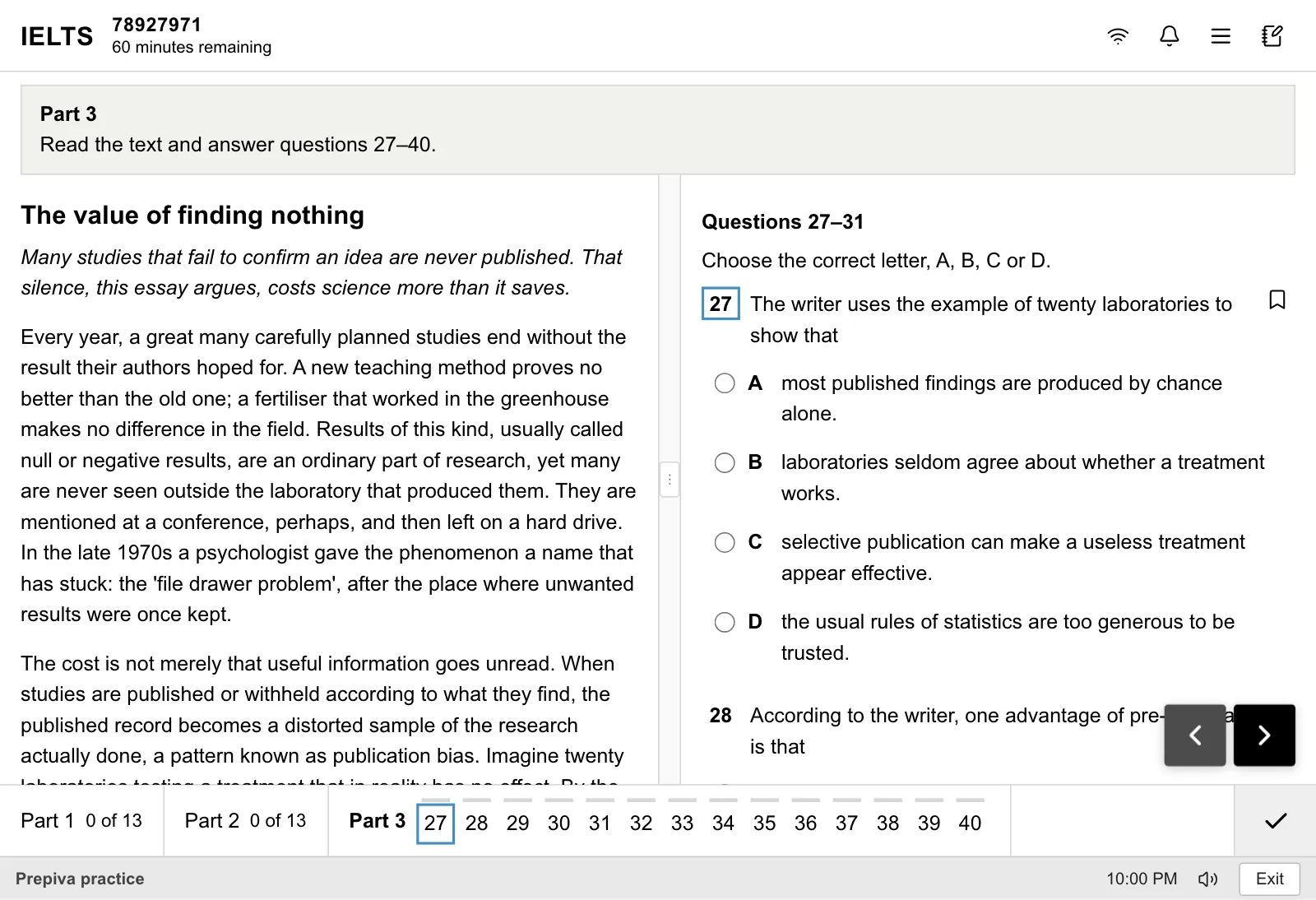
Each question has a stem and options A to D, or a longer list from which you choose two or three letters. Most questions are about one part of the passage and follow its order. A question about the passage as a whole, such as the writer’s purpose or the best title, usually comes last.
How it is marked
One mark a question. When you choose two or three letters, each right letter earns one mark, in any order.
A step-by-step method
- Read the stem only, and underline what it asks.
- Find the place in the passage and read it closely.
- Answer in your own words before you look at the options.
- Choose the option that means the same, and rule out each other one with a reason.
- For the writer’s purpose, look at the conclusion and the ideas the writer returns to.
Common traps
- Same words, different meaning: an option that repeats the passage but changes it.
- True, but not the answer: an option the passage supports that does not answer this question.
- Strong words: always, only, never, when the passage is more careful.
- The wrong part: an option that is true of another paragraph.
A worked example
Community fridges
Community fridges, where anyone can leave or take food, have spread to hundreds of towns. Their organisers say the main purpose is not to feed people in need, although the fridges do that, but to stop edible food from being thrown away. Shops and cafés are the largest donors; households give less than organisers had hoped.
According to the organisers, the main aim of community fridges is to
A. provide food for people in need.
B. reduce the amount of food that is wasted.
C. encourage shops to give away food.
D. bring neighbours together.
| Question | Answer | Why |
|---|---|---|
| 1 | B | “Stop edible food from being thrown away.” A happens but is “not” the main purpose; C is a fact about donors, not an aim; D is never mentioned. |
Practise it
In IELTS Academic Practice Test 1, Reading Passage 3 opens with five questions with options A to D, before Yes, No or Not Given statements on the same passage.
No account or card to start. Free account to see your report.
FAQ
Are Reading multiple-choice questions in passage order?
Usually, yes. A question about the passage as a whole, such as the writer’s purpose or the best title, tends to come last.
How are choose-two questions marked in IELTS Reading?
Each right letter earns one mark, so choosing two letters is worth two marks. The order of the letters does not matter.
Should I read the options before the passage?
Read the stem first and find the place in the passage. Reading all the options first plants the wrong ones in your head; check them once you know what the passage says.
More on IELTS
- Yes, No, Not GivenYes, No, Not Given asks for the writer’s views, not facts. How to spot them, how it differs from True, False, Not Given and a worked example.
- Matching informationMatching information, matching features and sentence endings in IELTS Reading: which are in order, a method for each and a worked example.
- Listening multiple choiceSingle-answer, choose-two and matching questions in IELTS Listening: how they are marked, a method, the usual traps and a worked example.
Prepiva is an independent practice platform and is not affiliated with, endorsed by or approved by the British Council, IDP: IELTS Australia or Cambridge University Press & Assessment. IELTS is a registered trademark of the British Council, IDP: IELTS Australia and Cambridge University Press & Assessment. Prepiva scores are practice estimates, not official results.