
IELTS Listening Multiple Choice 2026: Single Answers, Choose Two and Matching
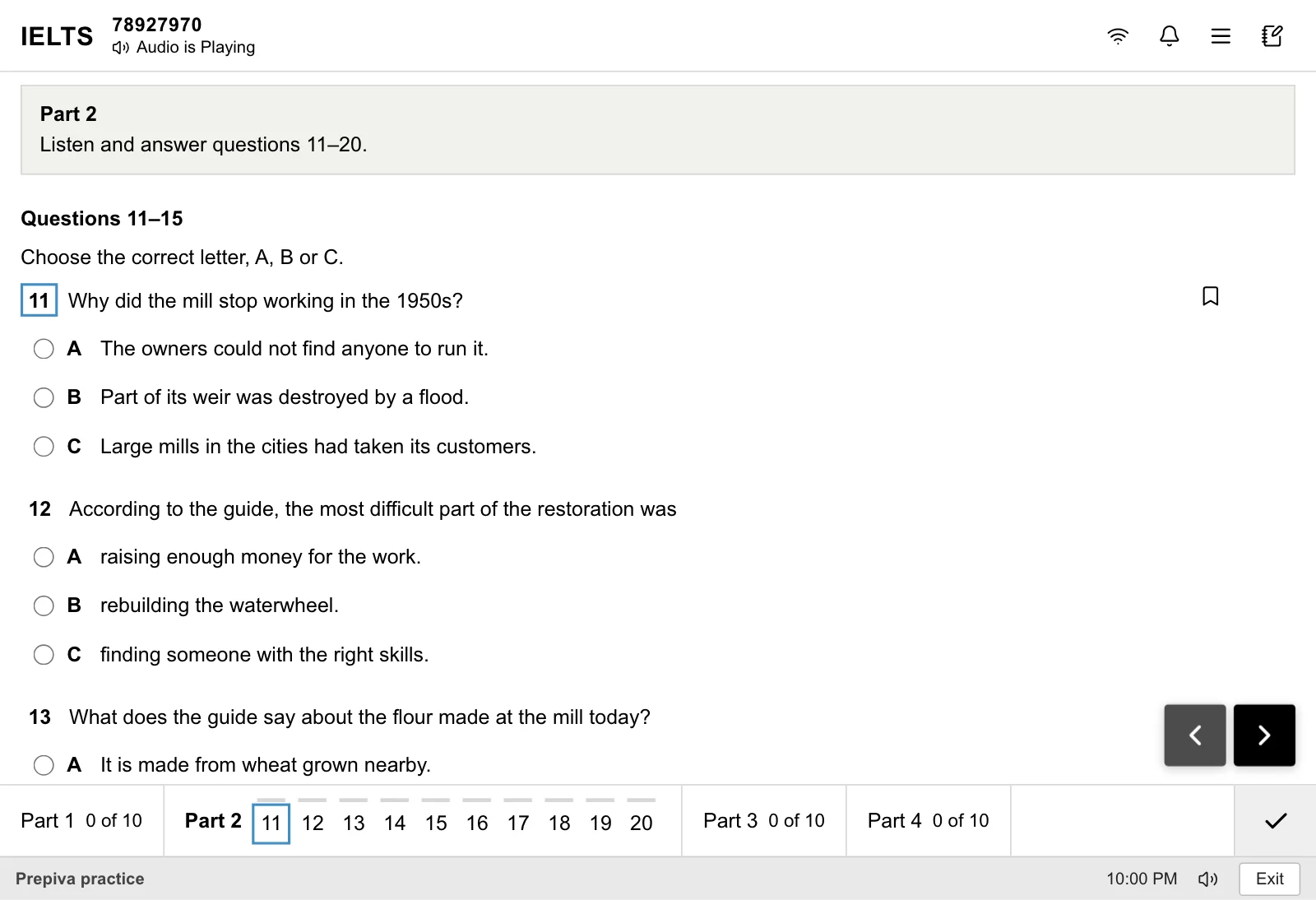
Listening multiple choice asks for one answer from A, B or C, or for two or three answers from a longer list. Matching asks you to link each item to an option in a box. All three reward listening for meaning, not for words.
By the Prepiva team · Last reviewed · How we make and review our content
On this page
What the task looks like
| Type | On screen | You choose |
|---|---|---|
| Single answer | A question with options A, B and C | One option |
| Choose two or three | A question with five or more options | Two or three letters |
| Matching | Numbered items and a box of lettered options | One letter for each item |
These types are common in Parts 2 and 3. The questions follow the order of the recording; the options inside a question do not.
How it is marked
- Single answer: one mark.
- Choose two or three: the question covers two or three numbers, and each right letter earns one mark, in any order.
- Matching: one mark an item. The box has more options than items; use an option twice only if the instruction allows it.
A step-by-step method
- In the reading time, read each question stem and underline its key idea.
- Put the options in your own words: the speakers will rarely use the same ones.
- Listen for the speaker’s final view or decision, not the first idea raised.
- In choose two or three, cross out each option as the speakers rule it out.
- In matching, keep your eyes on the item number, then scan the box for the meaning you hear.
Common traps
- Every option is mentioned. Two of them are raised and then rejected.
- A change of mind: “We were going to… but in the end we decided…”
- Who says it: in Part 3 the answer is often what the speakers agree on, not one speaker’s first idea.
- A “not” in the stem: “Which is NOT a reason…” flips what you listen for.
A worked example
Recording (extract)
Tutor: I see you rewrote your questionnaire. Was it too long?
Maya: People did say it took a while, but that wasn’t really the problem.
Sam: No. Half the people we tried it on read question four in two different ways, so we reworded the lot to make it clearer.
Tutor: Good. I was going to suggest that myself.
Why did the students change their questionnaire?
A. It took too long to complete.
B. Some questions could be understood in more than one way.
C. Their tutor asked them to.
| Question | Answer | Why |
|---|---|---|
| 1 | B | “Read question four in two different ways” means a question was unclear. A is raised and dismissed. C is a trap: the tutor only says she would have suggested it. |
Practise it
In IELTS Academic Practice Test 1, Listening Part 2 opens with single-answer questions, and Part 3 has a choose-two question, more single answers and a matching box. Your report shows each question you missed.
No account or card to start. Free account to see your report.
FAQ
How is “choose two letters” marked in IELTS Listening?
Each right letter earns one mark, so a choose-two question is worth two marks. The order of the letters does not matter.
Are multiple-choice questions in the order of the recording?
Yes, the questions follow the recording. The options A, B and C do not: the speaker may mention C first.
Can I use an option twice in Listening matching?
Only if the instruction says you may. Usually the box has more options than questions, and some are not used.
More on IELTS
- Form completionForm, note, table and flow-chart completion in IELTS Listening: word limits, spelling, the traps speakers set and a worked example.
- Map labellingHow to label a plan, map or diagram in IELTS Listening: find the start, follow the route and know your direction words. With a worked example.
- Reading multiple choiceMultiple choice in IELTS Reading: one answer, choose two or three and the writer’s purpose. How to rule out wrong options, with an example.
Prepiva is an independent practice platform and is not affiliated with, endorsed by or approved by the British Council, IDP: IELTS Australia or Cambridge University Press & Assessment. IELTS is a registered trademark of the British Council, IDP: IELTS Australia and Cambridge University Press & Assessment. Prepiva scores are practice estimates, not official results.