
IELTS Writing Task 2 2026: Essay Types, Structure and the Band Criteria
Task 2 is an essay of at least 250 words, in about 40 minutes, in answer to a view, an argument or a problem. It counts twice as much as Task 1, so it decides most of your Writing band.
By the Prepiva team · Last reviewed · How we make and review our content
On this page
The question types
| Type | What the question asks |
|---|---|
| Opinion | How far you agree or disagree with a statement |
| Discussion | Both views discussed, and usually your own opinion |
| Advantages and disadvantages | Both sides, sometimes which outweighs the other |
| Problem and solution | Causes or problems, and ways to solve them |
| Two-part question | Two separate questions about one topic, both answered |
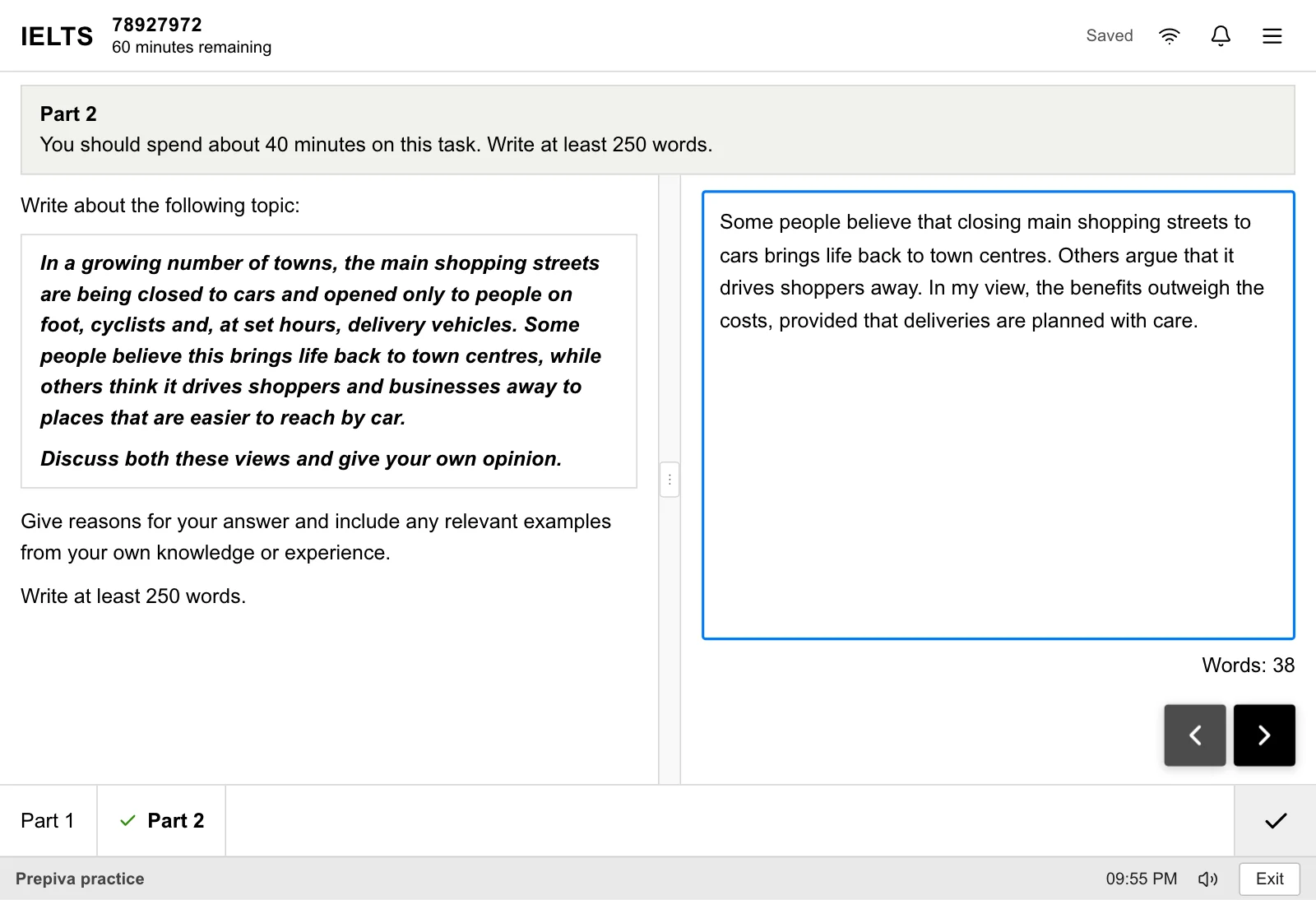
On computer the question sits beside the answer box, with a word count. Some questions mix two types; answer every part.
How it is marked
| Criterion | What it looks for in Task 2 |
|---|---|
| Task Response | Every part answered, a clear position throughout, ideas extended and supported |
| Coherence and Cohesion | Paragraphs with one central idea each, a logical order, clear linking |
| Lexical Resource | A range of precise vocabulary, used naturally and spelled correctly |
| Grammatical Range and Accuracy | Complex as well as simple sentences, with few errors |
The four count equally. Under 250 words loses marks for Task Response, and so does an essay that drifts off the question.
A step-by-step method
- Spend about 5 minutes reading the question twice, underlining each part and deciding your position.
- Plan two or three main ideas, each with a reason and an example.
- Introduction: say what the issue is in your own words, and give your position.
- Body paragraphs: a topic sentence, an explanation, an example.
- Conclusion: restate your position; no new ideas.
- Keep 3 to 5 minutes to check grammar, spelling and the word count.
Common traps
- Writing about the topic, not the question: an essay on students and work that never says whether you agree.
- A position that shifts between the introduction and the conclusion.
- Many ideas, none developed: two well-supported points beat five listed ones.
- Memorised phrases that do not fit the question.
- A long introduction that leaves no time for the body.
A worked example
Question
Some people believe every university student should spend one term working in a job outside their field of study. To what extent do you agree or disagree?
| Paragraph | Content |
|---|---|
| Introduction | Position: largely agree, if universities organise the placements |
| Body 1 | Graduates often change field; work experience builds skills any job needs. Example: a chemistry student in a busy shop learns to deal with people |
| Body 2 | The cost: a longer degree and lost study time. Answer: short, paid, credited placements |
| Conclusion | Restate: a good idea, as long as it is planned well |
Introduction
Most degrees prepare students for one career, yet many graduates end up working in another. For this reason, I largely agree that a term spent working outside one’s subject would benefit students, provided that universities arrange these placements rather than leaving students to find them alone.
Practise it
In IELTS Academic Practice Test 1, Task 2 follows Task 1 on one 60-minute clock, so you practise the time split too. Your essay is rated on the four criteria, with a band for each.
No account or card to start. Free account to see your report.
FAQ
How many words should I write for IELTS Writing Task 2?
At least 250. Essays under 250 words lose marks for Task Response. Many candidates aim for about 270 to 320 words, which leaves time to plan and check.
Should I give my opinion in Task 2?
When the question asks for it, yes: state it in the introduction and keep it the same to the conclusion. When the question asks only for causes or solutions, answer exactly that.
Can I use memorised phrases or essays in IELTS Writing?
Memorised language that does not fit the question is not credited and can lower your band. Learn structures and linking words, then write for the question in front of you.
How many paragraphs should a Task 2 essay have?
Four or five is common: an introduction, two or three body paragraphs and a conclusion. There is no fixed number, but each paragraph should have one clear central idea.
More on IELTS
- Writing Task 1Academic Writing Task 1: graphs, tables, processes and maps in 150 words. The four criteria, a six-step method and a sample overview.
- IELTS band scoresHow IELTS is scored: the 0–9 bands, Listening and Academic Reading raw scores to bands, the Writing and Speaking criteria and how the overall band is rounded.
- IELTS study planPrepare for IELTS Academic in four steps: take a full mock test, find your weakest skill, train it on the band criteria and test again before you book.
Prepiva is an independent practice platform and is not affiliated with, endorsed by or approved by the British Council, IDP: IELTS Australia or Cambridge University Press & Assessment. IELTS is a registered trademark of the British Council, IDP: IELTS Australia and Cambridge University Press & Assessment. Prepiva scores are practice estimates, not official results.