
IELTS Writing Task 1 Academic 2026: Charts, Tables, Processes and Maps
In Academic Task 1 you describe visual information in at least 150 words, in about 20 minutes. A clear overview and accurate comparisons earn the band, not every number.
By the Prepiva team · Last reviewed · How we make and review our content
On this page
What the task looks like
The visual is a line graph, a bar chart, a pie chart, a table or a mix of them, a diagram of a process, or two maps of a place at different times. On computer the task sits beside the answer box, with a word count as you type.
Writing is one 60-minute section for both tasks, so you keep the time yourself. You report what the visual shows; no opinion is asked for.
How it is marked
| Criterion | What it looks for in Task 1 |
|---|---|
| Task Achievement | An overview, the key features picked out, accurate figures, comparisons where relevant |
| Coherence and Cohesion | Data grouped logically, clear paragraphs, linking that helps the reader |
| Lexical Resource | Precise words for trends, comparisons and stages, spelled correctly |
| Grammatical Range and Accuracy | A mix of sentence structures with few errors |
The four count equally. An answer under 150 words loses marks for Task Achievement. Task 1 counts half as much as Task 2 in the Writing band.
A step-by-step method
- Read the title, axes and units: what is measured, where and when.
- Find two or three main features: the overall trend, the highest and lowest, the biggest change.
- Write one sentence that says what the visual shows, in your own words.
- Write the overview: two sentences on the main features, no figures needed.
- Write two body paragraphs that group the data, with figures to support each point.
- Check the figures, the tenses and the word count.
Common traps
- No overview: the public band descriptors expect one, and Task Achievement stays low without it.
- Every number listed: pick out and compare instead.
- Reasons that are not shown: do not explain why a figure changed.
- Copying the prompt: language copied from the task is not credited.
- Processes and maps: describe the stages in order, or what was added, removed and moved, rather than trends.
A worked example
| City | 2005 | 2015 | 2025 |
|---|---|---|---|
| Arlen | 4% | 9% | 15% |
| Bexford | 12% | 11% | 10% |
| Corvale | 2% | 3% | 3% |
Overview
Overall, cycling became far more popular in Arlen, while it fell slightly in Bexford and stayed rare in Corvale. By 2025 Arlen had the highest share of the three.
Part of a body paragraph
In Arlen, the share of trips made by bike almost quadrupled, rising from 4% in 2005 to 15% in 2025. Bexford, which began with the highest figure at 12%, saw a gradual decline to 10%.
The overview has no figures and names the biggest change and the final ranking. The body groups the cities and compares them, with figures as support.
Practise it
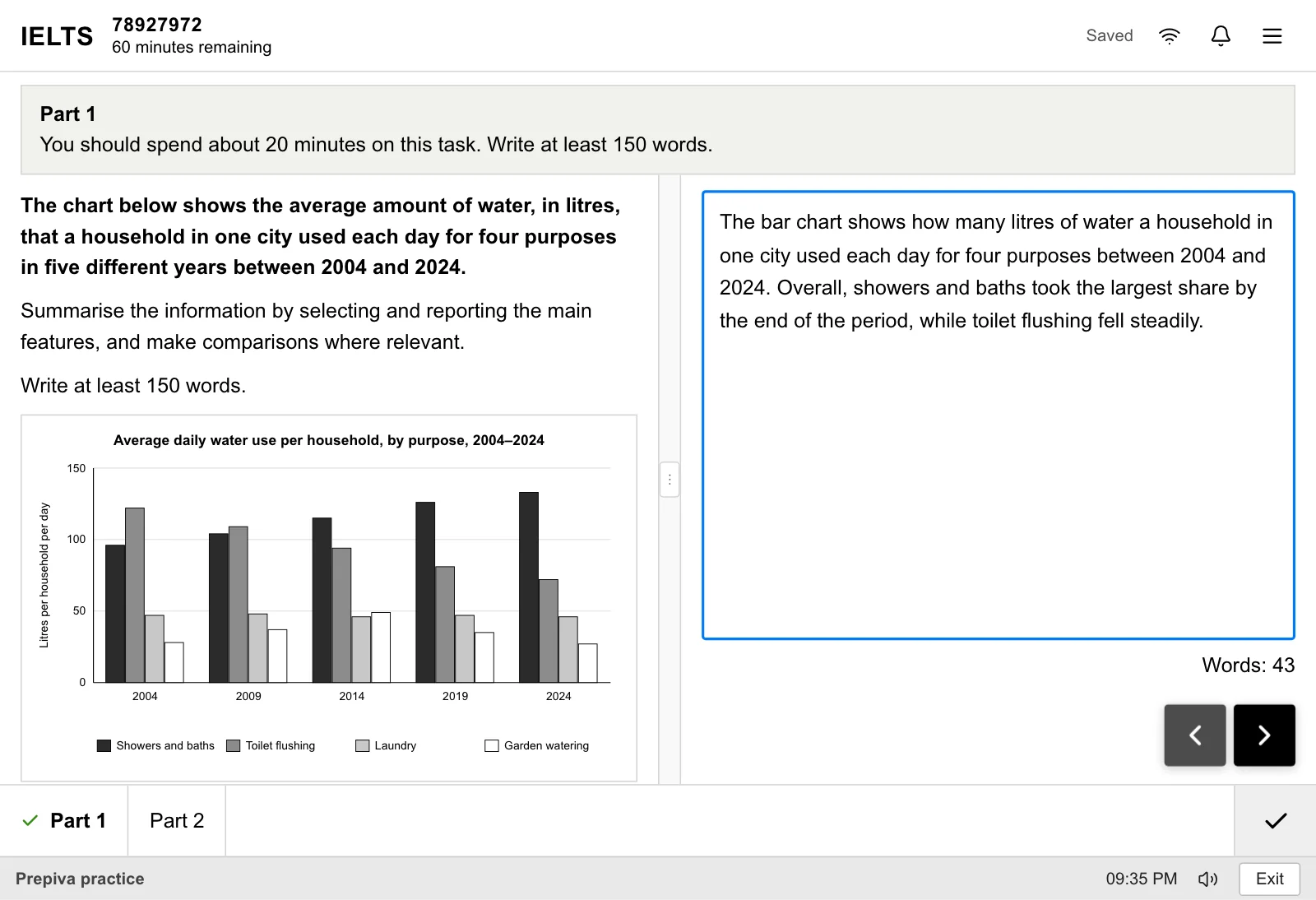
In IELTS Academic Practice Test 1, Task 1 is a bar chart, with a live word count and one clock for both tasks. Your answer is rated on the four criteria, with a band for each. See how the Writing band is worked out.
No account or card to start. Free account to see your report.
FAQ
How many words should I write for IELTS Writing Task 1?
At least 150. Answers under 150 words lose marks for Task Achievement. Writing far more than about 200 words takes time away from Task 2.
Do I need a conclusion in Task 1?
You need an overview: one or two sentences that sum up the main trends or features. It can follow the introduction or come at the end; what matters is that it is there.
Should I give my opinion in Academic Task 1?
No. Academic Task 1 asks you to report what the visual shows. Opinions, and reasons that are not in the data, do not earn marks.
How long should I spend on Task 1?
About 20 minutes. Task 2 counts twice as much, so keep about 40 minutes for it.
More on IELTS
- Writing Task 2IELTS Writing Task 2: the five essay types, the four band criteria, a plan for 40 minutes and a sample introduction. At least 250 words.
- IELTS band scoresHow IELTS is scored: the 0–9 bands, Listening and Academic Reading raw scores to bands, the Writing and Speaking criteria and how the overall band is rounded.
- IELTS test formatEvery part of IELTS Academic: Listening's 4 parts, Reading's 3 passages, Writing Tasks 1 and 2 and the Speaking interview, with timing and question types.
Prepiva is an independent practice platform and is not affiliated with, endorsed by or approved by the British Council, IDP: IELTS Australia or Cambridge University Press & Assessment. IELTS is a registered trademark of the British Council, IDP: IELTS Australia and Cambridge University Press & Assessment. Prepiva scores are practice estimates, not official results.