
IELTS Academic Test Format 2026: Every Part, Its Timing and Its Questions
IELTS Academic has four sections: Listening, Reading, Writing and Speaking. They take about 2 hours 45 minutes, and each gets a band from 0 to 9. This page goes through each part, its timing and its question types.
By the Prepiva team · Last reviewed · How we make and review our content
On this page
The test at a glance
Listening
30 min · 4 parts · 40 questions
Reading
60 min · 3 passages · 40 questions
Writing
60 min · Task 1 · Task 2
Speaking
11–14 min · 3 parts
| Section | Time | What you do |
|---|---|---|
| Listening | About 30 minutes | 4 recordings, 40 questions; each recording is heard once |
| Reading | 60 minutes | 3 long passages, 40 questions |
| Writing | 60 minutes | Task 1: at least 150 words on a chart, table, diagram or map. Task 2: an essay of at least 250 words |
| Speaking | 11–14 minutes | An interview with an examiner in three parts |
Listening, Reading and Writing are taken in one sitting with no breaks. Speaking can be on the same day or up to a week before or after.
Listening: 4 parts, 40 questions
| Part | Recording | Questions |
|---|---|---|
| 1 | A conversation between two people in an everyday situation (booking, enquiring) | 10 |
| 2 | One speaker in an everyday setting (a tour, a talk about local facilities) | 10 |
| 3 | Up to four people in an education or training setting (students and a tutor) | 10 |
| 4 | One speaker on an academic subject (a lecture) | 10 |
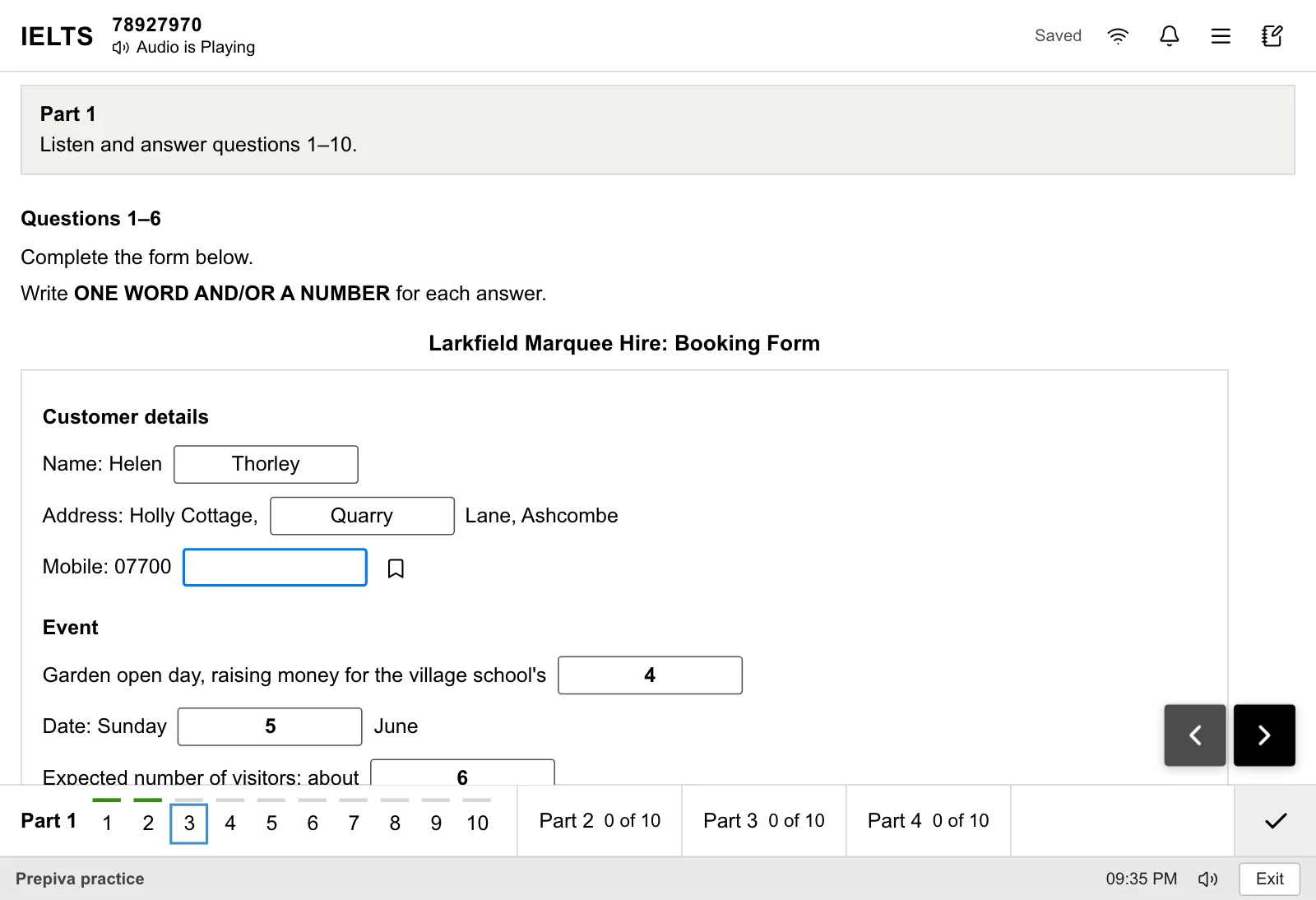
Question types include multiple choice, matching, labelling a plan, map or diagram, and completing a form, notes, a table, a flow chart, a summary or sentences. Spelling counts in typed answers. On paper there are 10 extra minutes to copy answers onto the answer sheet; on computer there are 2 minutes to check them.
Reading: 3 passages, 60 minutes
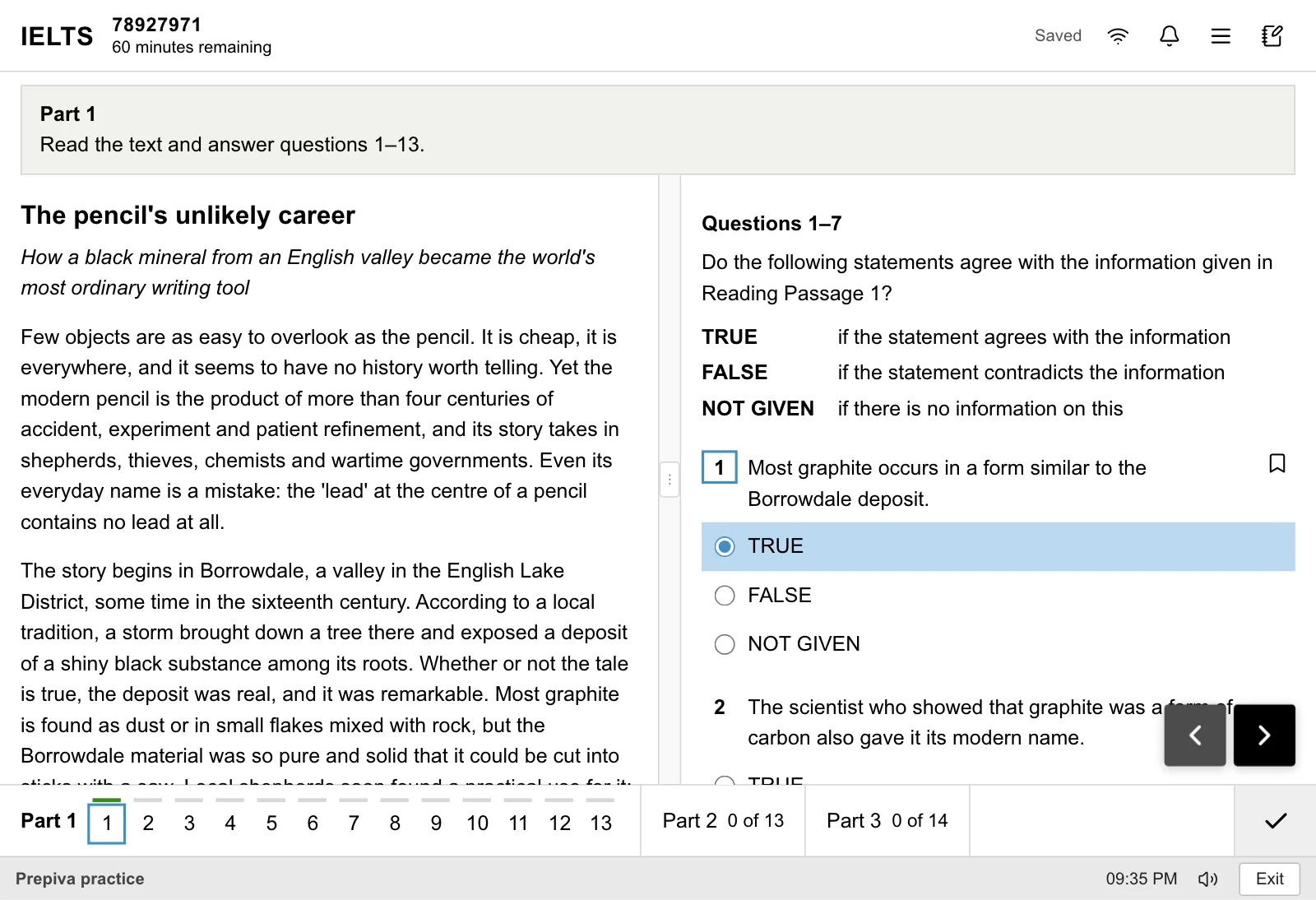
The three Academic passages come from books, journals, magazines and newspapers, written for a general audience, and get harder from first to last. They add up to roughly 2,150 to 2,750 words. There is no extra time to copy answers, so about 20 minutes a passage is a sensible pace.
Question types: multiple choice; True, False or Not Given (facts in the passage); Yes, No or Not Given (the writer’s views); matching headings, information, features and sentence endings; completing sentences, summaries, notes, tables, flow charts and diagram labels; and short answers.
Writing: Task 1 and Task 2, 60 minutes
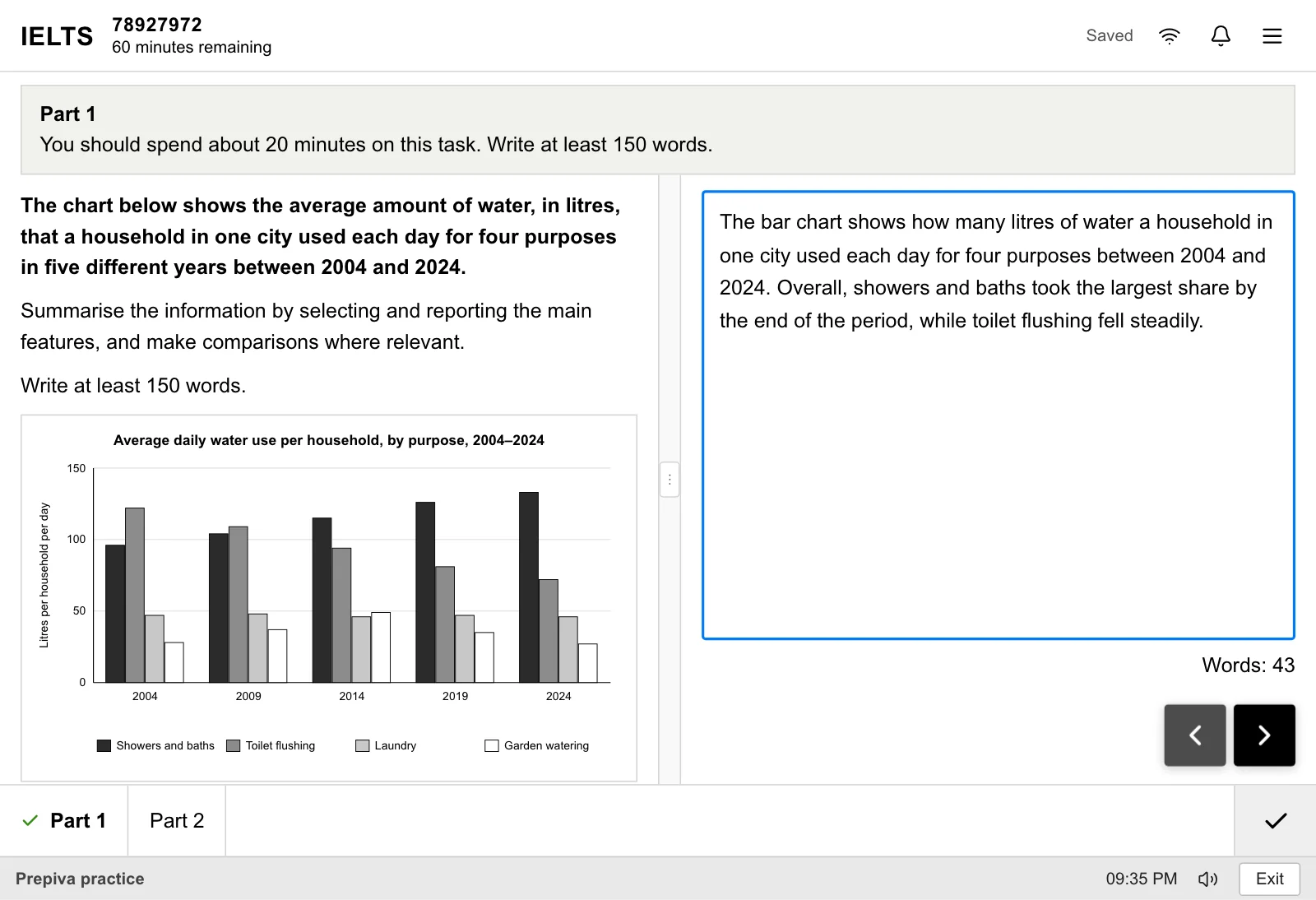
Task 1 (about 20 minutes, at least 150 words): describe, summarise or explain visual information, such as a graph, table, chart, a process diagram or maps that change over time. Give an overview and pick out the key features; no opinion is needed.
Task 2 (about 40 minutes, at least 250 words): an essay in answer to a point of view, an argument or a problem. Task 2 counts twice as much as Task 1 in the Writing band.
Both tasks are rated on four criteria: Task Achievement (Task 1) or Task Response (Task 2), Coherence and Cohesion, Lexical Resource, and Grammatical Range and Accuracy.
Speaking: an interview in 3 parts
| Part | Time | What happens |
|---|---|---|
| 1. Introduction and interview | 4–5 minutes | Questions about familiar topics: home, work or studies, interests |
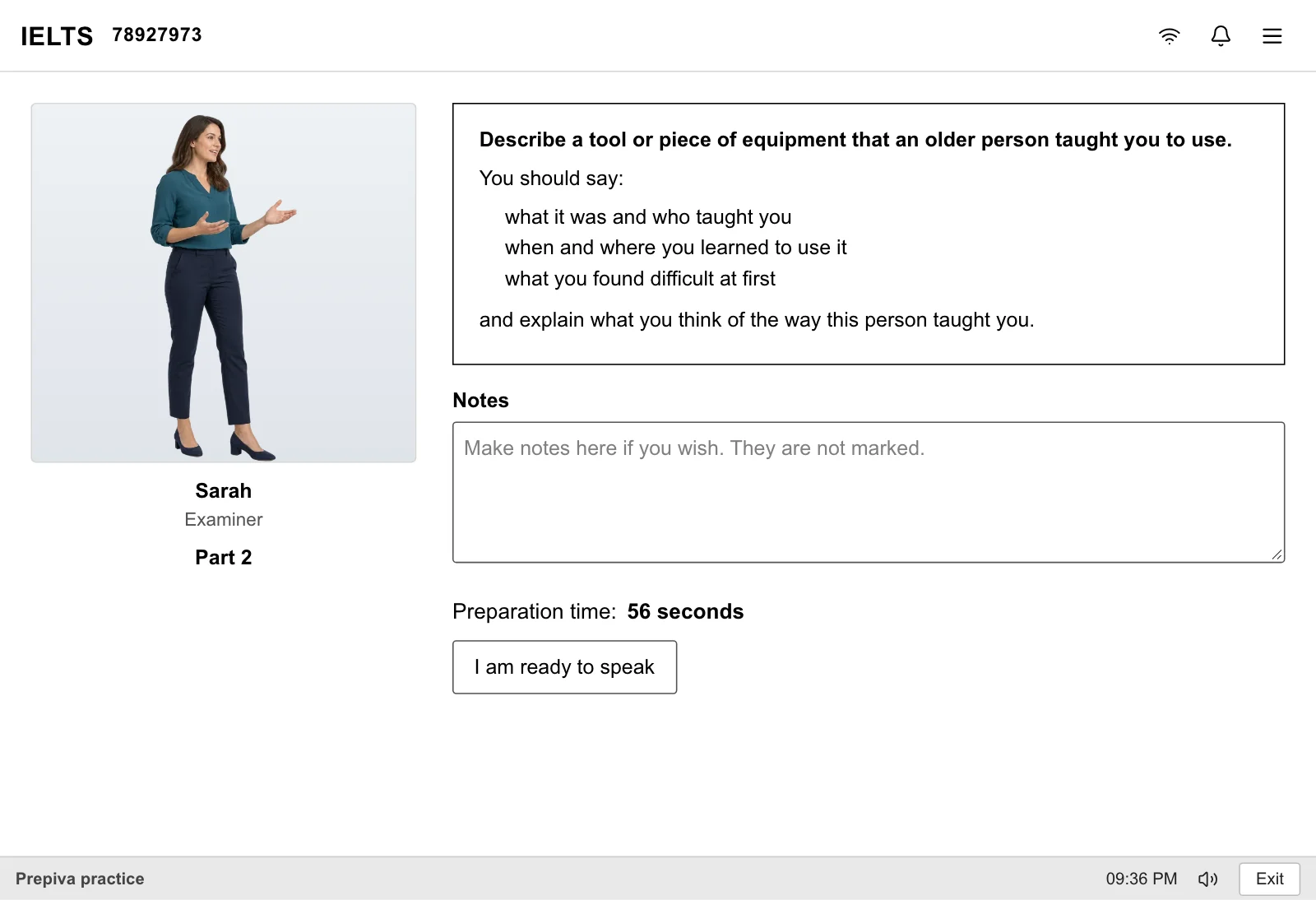
| 2. Long turn | 3–4 minutes | A cue card, one minute to prepare with notes, then up to two minutes of talk and one or two follow-up questions |
| 3. Discussion | 4–5 minutes | Broader, more abstract questions linked to the Part 2 topic |
Speaking is rated on Fluency and Coherence, Lexical Resource, Grammatical Range and Accuracy, and Pronunciation. On test day it is a conversation with an examiner, face to face or by video call; in the Prepiva test a recorded examiner asks the questions and your answers are recorded.
Academic or General Training?
IELTS Academic is the version universities and many professional bodies ask for. IELTS General Training is often asked for by migration programmes and for work or training. Listening and Speaking are the same in both; Reading uses everyday and workplace texts in General Training, and its Writing Task 1 is a letter.
Prepiva has IELTS Academic practice for now. Check which version your institution or programme asks for before you book.
Practise the whole format
IELTS Academic Practice Test 1 is a full IELTS Academic mock test in this order and timing, on computer-delivered screens. You get a band for each section and an overall band; see how the bands are worked out.
No account or card to start. Free account to see your report.
FAQ
How long is the IELTS Academic test?
About 2 hours 45 minutes: Listening about 30 minutes, Reading 60 minutes, Writing 60 minutes and Speaking 11 to 14 minutes.
How many questions are in IELTS Listening and Reading?
40 each. Listening has four parts of ten questions; Academic Reading has three passages with 40 questions in all.
How many words do I need to write in IELTS Writing?
At least 150 words for Task 1 and at least 250 words for Task 2. Task 2 counts twice as much as Task 1.
Is the computer-delivered IELTS different from the paper test?
The content, question types and timing are the same. On computer you type your answers, and in Listening you get 2 minutes to check your answers instead of 10 minutes to transfer them to an answer sheet.
More on IELTS
- IELTSTen full IELTS Academic mock tests on computer-delivered screens: a 0–9 band for each skill and your overall band, Writing and Speaking rated. One is free.
- IELTS band scoresHow IELTS is scored: the 0–9 bands, Listening and Academic Reading raw scores to bands, the Writing and Speaking criteria and how the overall band is rounded.
- IELTS study planPrepare for IELTS Academic in four steps: take a full mock test, find your weakest skill, train it on the band criteria and test again before you book.
- IELTS on computerIELTS paper tests end from mid-2026. What the computer test looks like section by section, Writing on Paper, IELTS Online, results in 1 to 5 days.
- Academic or General TrainingIELTS Academic or General Training? Who needs which, what Canada, Australia and the UK ask for now, and how Reading and Writing differ between the two.
- IELTS vs PTE AcademicIELTS or PTE Academic? Length, Speaking, scoring and results compared, with what Australia, the UK and Canada accept and Home Affairs’ minimum scores.
Prepiva is an independent practice platform and is not affiliated with, endorsed by or approved by the British Council, IDP: IELTS Australia or Cambridge University Press & Assessment. IELTS is a registered trademark of the British Council, IDP: IELTS Australia and Cambridge University Press & Assessment. Prepiva scores are practice estimates, not official results.