
IELTS Reading True, False, Not Given 2026: A Method That Works
True, False or Not Given asks whether statements agree with the facts in a passage. The hard part is telling False from Not Given, and that is a skill you can practise.
By the Prepiva team · Last reviewed · How we make and review our content
On this page
What the task looks like
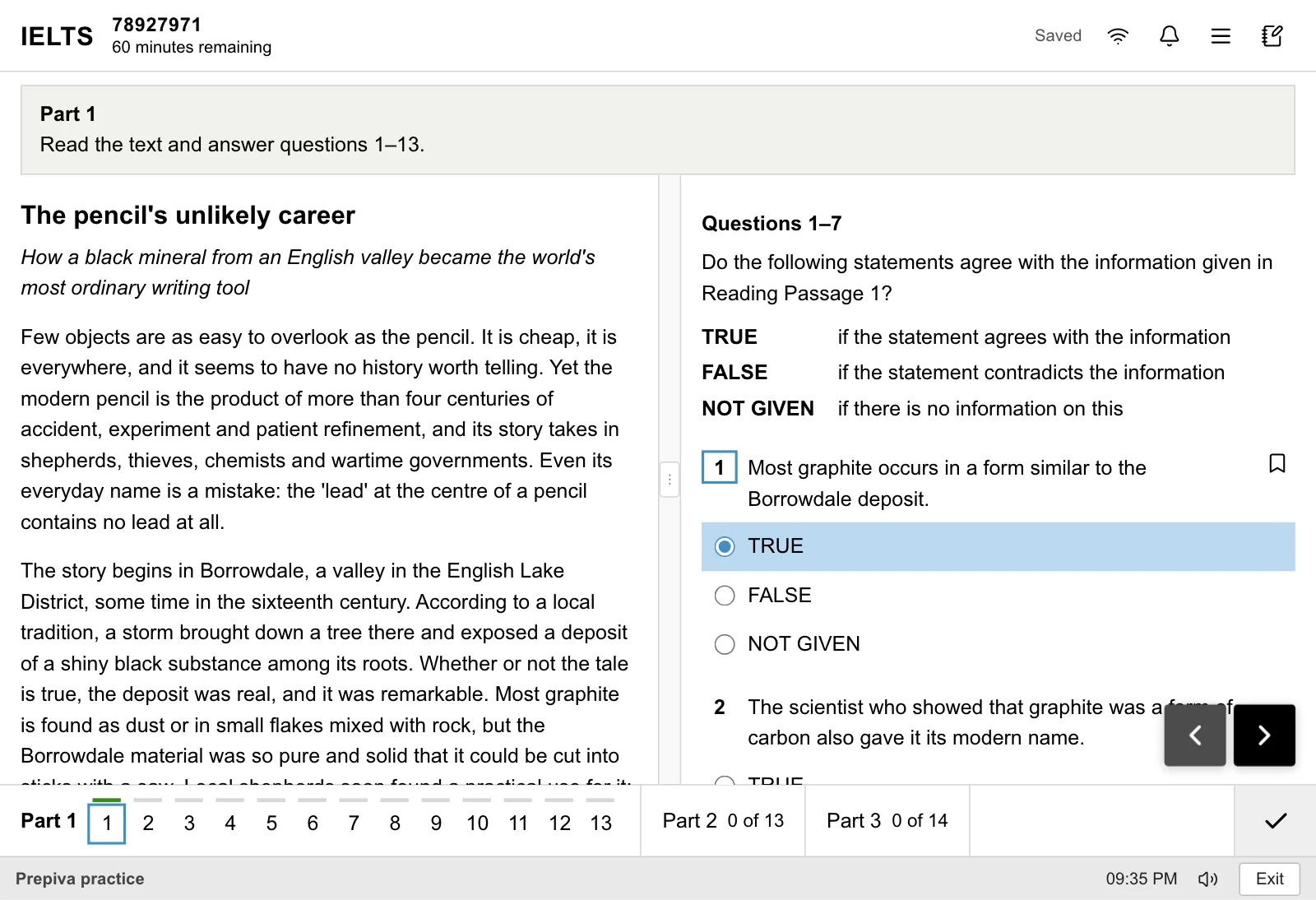
The passage is on the left of the screen and a list of statements on the right. For each statement you choose TRUE, FALSE or NOT GIVEN. The statements follow the order of the passage, so each answer is usually a little further on than the last.
How it is marked
One mark a statement. Judge it only by the passage, never by what you know about the topic.
| Answer | When to choose it |
|---|---|
| TRUE | The passage says the same thing, usually in other words. |
| FALSE | The passage says the opposite, or something that cannot be true at the same time. |
| NOT GIVEN | The passage does not say, or does not say enough to decide. |
A step-by-step method
- Underline the topic words and the limiting words of the statement: all, some, only, first, never, more than.
- Find the place in the passage. Names, numbers and dates help, and the order helps too.
- Read that sentence and the ones around it closely.
- Compare the limiting words: “several residents” is not “all residents”.
- Decide: same meaning is True, a contradiction is False, nothing to check against is Not Given.
- Spend no more than a minute or so on one statement; come back if needed.
Common traps
- Matching words, different meaning: the statement reuses the passage’s words but changes who, when or how much.
- Your own knowledge: a statement can be true in the real world and Not Given in the passage.
- Half a match: the passage confirms one part of the statement and says nothing about the other. That is not True.
- Comparisons the passage never makes: “more than”, “the first”, “the largest”.
A worked example
The glass reading room
When the Marlow Public Library reopened in 2019, its new glass reading room drew three times as many visitors in its first month as the old building had seen in a whole year. Not everyone was pleased: several residents complained that the room grew uncomfortably hot in summer, and blinds were fitted the following spring. The architect, who had designed two other libraries in the region, said the new building used less energy than the old one.
| Question | Answer | Why |
|---|---|---|
| 1. The library had more visitors in its first month after reopening than in a year before. | TRUE | “Three times as many… as the old building had seen in a whole year.” |
| 2. All local residents liked the glass reading room. | FALSE | “Several residents complained” contradicts “all”. |
| 3. The blinds were paid for by local residents. | NOT GIVEN | The blinds are mentioned; who paid for them is not. |
| 4. The library was the architect’s first. | FALSE | The architect had designed two other libraries. |
Practise it
In IELTS Academic Practice Test 1, Reading Passage 1 opens with seven True, False or Not Given statements, and Passage 3 has Yes, No or Not Given questions on the writer’s views. Learn the difference on Yes, No, Not Given.
No account or card to start. Free account to see your report.
FAQ
What is the difference between False and Not Given?
False means the passage says the opposite of the statement. Not Given means the passage does not say whether the statement is true, so you cannot check it.
Are True, False, Not Given questions in order?
Yes. The statements follow the order of the information in the passage, which helps you find each one.
Can I use my own knowledge in True, False, Not Given?
No. Judge each statement only by the passage, even when you know the topic. A statement can be true in the real world and Not Given in the passage.
More on IELTS
- Yes, No, Not GivenYes, No, Not Given asks for the writer’s views, not facts. How to spot them, how it differs from True, False, Not Given and a worked example.
- Matching headingsHow to match headings to paragraphs in IELTS Reading: find the main idea fast, avoid the decoy headings and see a worked example.
- Summary completionSummary, note, table and sentence completion and short answers in IELTS Reading: word limits, spelling, word boxes and a worked example.
Prepiva is an independent practice platform and is not affiliated with, endorsed by or approved by the British Council, IDP: IELTS Australia or Cambridge University Press & Assessment. IELTS is a registered trademark of the British Council, IDP: IELTS Australia and Cambridge University Press & Assessment. Prepiva scores are practice estimates, not official results.