
IELTS Reading Yes, No, Not Given 2026: Reading the Writer’s Views
Yes, No or Not Given looks like True, False or Not Given, but it asks about the writer’s views and claims, not facts. It usually comes with a passage that argues a case.
By the Prepiva team · Last reviewed · How we make and review our content
On this page
What the task looks like
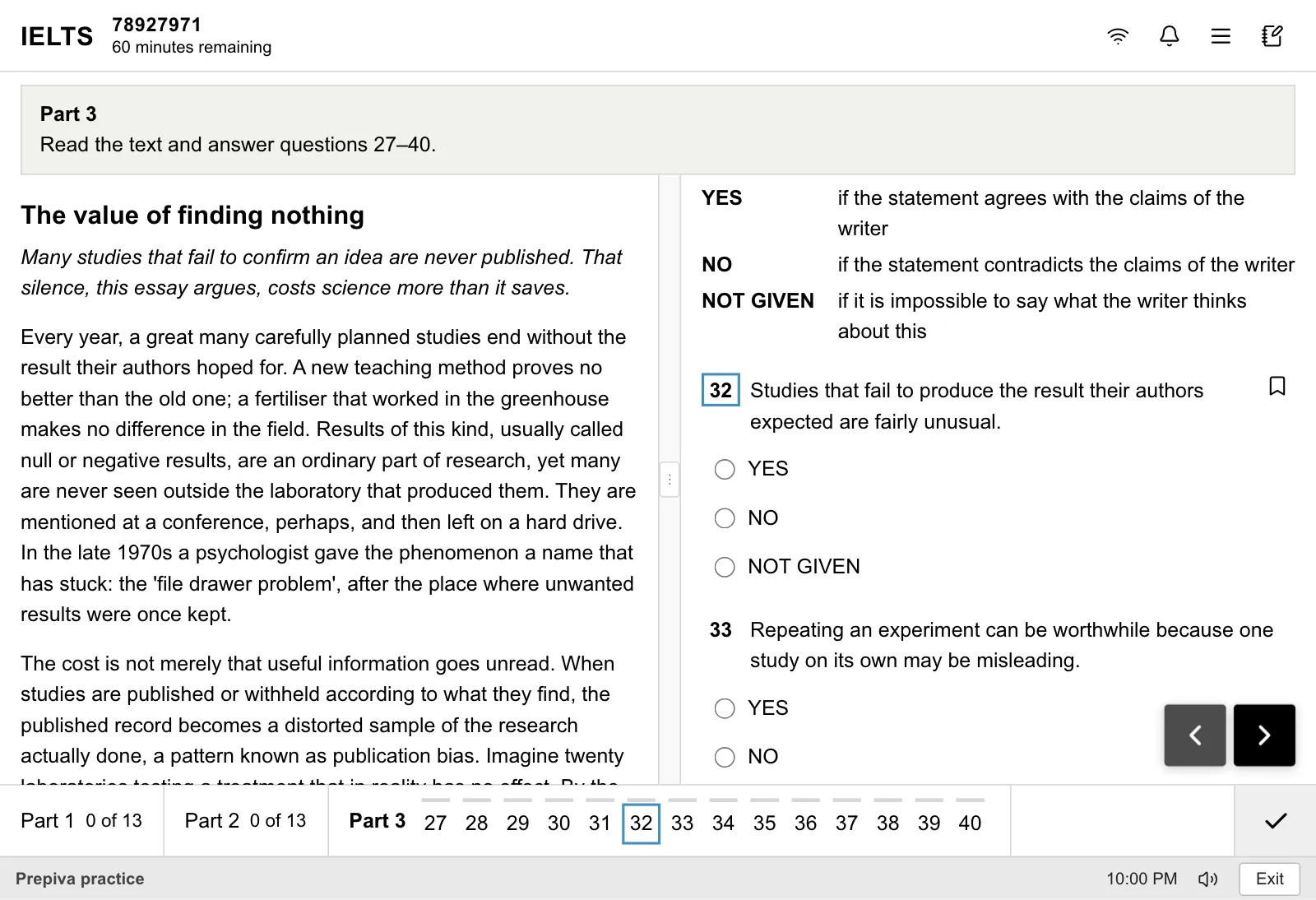
The instruction asks whether each statement agrees with the views or claims of the writer. On screen you choose YES, NO or NOT GIVEN for each one. As with True, False or Not Given, the statements follow the order of the passage.
How it is marked
One mark a statement. What counts is the writer’s position, not whether the statement is a fact.
| Answer | When to choose it |
|---|---|
| YES | The statement agrees with the writer’s view or claim. |
| NO | The statement contradicts the writer’s view or claim. |
| NOT GIVEN | It is impossible to say what the writer thinks about this. |
On the paper test, write the words the instruction asks for: YES or NO, not TRUE or FALSE.
A step-by-step method
- Find the topic of the statement in the passage.
- Ask whose view it is: the writer’s own, or one the writer reports (“critics argue”, “supporters say”).
- Look for the writer’s stance words: clearly, a mistake, unconvincing, I suspect, it would be better to.
- Check the strength: a writer who says “may” has not said “will”.
- Decide: agrees is Yes, contradicts is No, silent is Not Given.
Common traps
- Reported views: the writer quotes an opinion in order to disagree with it.
- Hedged views: “arguably”, “to some extent” and “perhaps” soften a claim; the statement may be stronger.
- Facts without a view: the writer describes something but never says whether it is good or bad.
- Your own opinion: agreeing with a statement does not make the answer Yes.
A worked example
Free museums, the wrong argument
Supporters of free entry to national museums often point to rising visitor numbers. Those numbers are real, but they tell us less than we might think: much of the rise comes from people who already visited and now simply come more often. If the aim is to reach new audiences, free entry alone is a blunt tool. None of this means charges should return. The case for free entry is a fair one; it is just not the case its supporters usually make.
| Question | Answer | Why |
|---|---|---|
| 1. Visitor numbers have risen since entry became free. | YES | “Those numbers are real.” |
| 2. Free entry has brought many new people into museums. | NO | Much of the rise comes from people who already visited. |
| 3. Museums should bring back entry charges. | NO | “None of this means charges should return.” |
| 4. Museums with free entry receive more government money. | NOT GIVEN | Funding is never mentioned. |
Practise it
In IELTS Academic Practice Test 1, Reading Passage 3 has five Yes, No or Not Given statements on the writer’s claims, and Passage 1 has True, False or Not Given. Doing both in one test is the best way to keep them apart.
No account or card to start. Free account to see your report.
FAQ
What is the difference between Yes, No, Not Given and True, False, Not Given?
True, False, Not Given checks statements against the facts in the passage. Yes, No, Not Given checks them against the writer’s views or claims.
How do I find the writer’s opinion in IELTS Reading?
Look for evaluative words and phrases such as clearly, a mistake, unconvincing, would be better, and for the writer’s conclusions, often at the end of a paragraph or the passage.
What if the passage reports someone else’s opinion?
A view the writer reports, such as what critics argue, is not automatically the writer’s own. Check whether the writer agrees, disagrees or does not say.
More on IELTS
- True, False, Not GivenTell False from Not Given in IELTS Reading: what each answer means, a step-by-step method, the common traps and a worked example.
- Reading multiple choiceMultiple choice in IELTS Reading: one answer, choose two or three and the writer’s purpose. How to rule out wrong options, with an example.
- Matching informationMatching information, matching features and sentence endings in IELTS Reading: which are in order, a method for each and a worked example.
Prepiva is an independent practice platform and is not affiliated with, endorsed by or approved by the British Council, IDP: IELTS Australia or Cambridge University Press & Assessment. IELTS is a registered trademark of the British Council, IDP: IELTS Australia and Cambridge University Press & Assessment. Prepiva scores are practice estimates, not official results.