
IELTS Reading Matching Information 2026: Paragraphs, Features and Sentence Endings
Three Reading tasks share one skill: finding where an idea sits in the passage. This page covers matching information, matching features and matching sentence endings.
By the Prepiva team · Last reviewed · How we make and review our content
On this page
The three matching tasks
| Task | You match | In passage order? |
|---|---|---|
| Matching information | Statements to the lettered paragraph that contains them | No |
| Matching features | Statements to a list of people, places, dates or theories | No |
| Sentence endings | Sentence beginnings to the right ending from a list | Yes |
How it is marked
One mark a question. In matching information and matching features, the instruction often says a letter may be used more than once; read it before you start. Sentence endings always come with more endings than you need.
A step-by-step method
- Matching information: note the kind of detail each statement asks for (an example, a reason, a figure). Then read paragraph by paragraph and check every statement against each one, instead of hunting for one statement at a time.
- Matching features: scan for each name, which is quick, then read what is said around every mention. A person can appear in more than one place.
- Sentence endings: find the beginning’s topic in the passage, then choose the ending that matches its meaning. Grammar can rule out an ending, but only meaning confirms one.
Common traps
- Type, not words: “a mention of a cost” will not use the word cost; look for a price or a figure.
- A detail, not the main idea: unlike headings, the match can be one sentence in the middle of a paragraph.
- Opinions that sound alike: two people in the passage may say similar things in different words.
- Endings that fit the grammar but say something the passage does not.
A worked example
City songbirds
Researchers disagree about why city birds sing at a higher pitch. Dr Ana Ruiz recorded robins in parks and beside busy roads and found that birds near traffic sang higher, which she put down to the low rumble of engines. Professor Tom Elling argued that size matters too: in his recordings, smaller birds sang higher wherever they lived. A third researcher, Dr Mei Chen, played recorded traffic noise to birds in a quiet forest and found that they raised their pitch within a single morning.
Match each statement with the correct researcher, A, B or C.
A. Ana Ruiz B. Tom Elling C. Mei Chen
1. Birds can change their song in a short time.
2. A bird’s body size affects how high it sings.
3. Birds were compared in two kinds of city location.
| Question | Answer | Why |
|---|---|---|
| 1 | C | “Within a single morning” means a short time. |
| 2 | B | “Smaller birds sang higher wherever they lived.” |
| 3 | A | Parks and busy roads are the two locations. |
Practise it
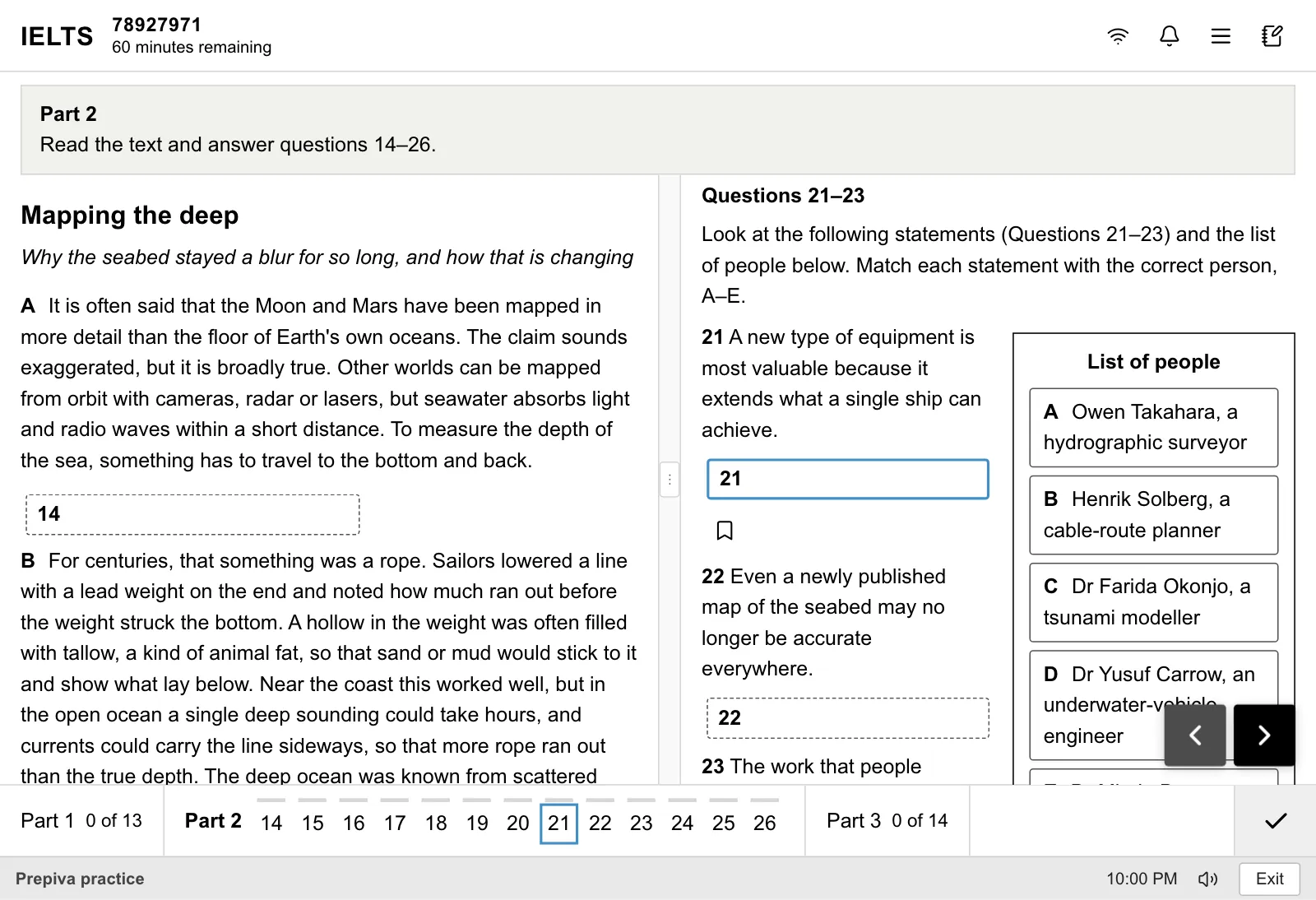
In IELTS Academic Practice Test 1, Reading Passage 2 asks you to match statements with a list of people, and Passage 3 ends with sentence endings. See how matching differs from matching headings.
No account or card to start. Free account to see your report.
FAQ
Are matching information questions in order?
No. Unlike most Reading question types, they can be in any order, so it helps to read the passage paragraph by paragraph and check every statement against each one.
Can I use the same letter more than once?
Only when the instruction says so. Matching information and matching features often allow it, so read the instruction before you start.
What is the difference between matching headings and matching information?
A heading sums up a whole paragraph. Matching information asks where one specific detail is, such as an example, a reason or a figure, which may be a single sentence.
More on IELTS
- Matching headingsHow to match headings to paragraphs in IELTS Reading: find the main idea fast, avoid the decoy headings and see a worked example.
- Summary completionSummary, note, table and sentence completion and short answers in IELTS Reading: word limits, spelling, word boxes and a worked example.
- Reading multiple choiceMultiple choice in IELTS Reading: one answer, choose two or three and the writer’s purpose. How to rule out wrong options, with an example.
Prepiva is an independent practice platform and is not affiliated with, endorsed by or approved by the British Council, IDP: IELTS Australia or Cambridge University Press & Assessment. IELTS is a registered trademark of the British Council, IDP: IELTS Australia and Cambridge University Press & Assessment. Prepiva scores are practice estimates, not official results.