
IELTS Reading Summary Completion 2026: Summaries, Notes, Tables and Short Answers
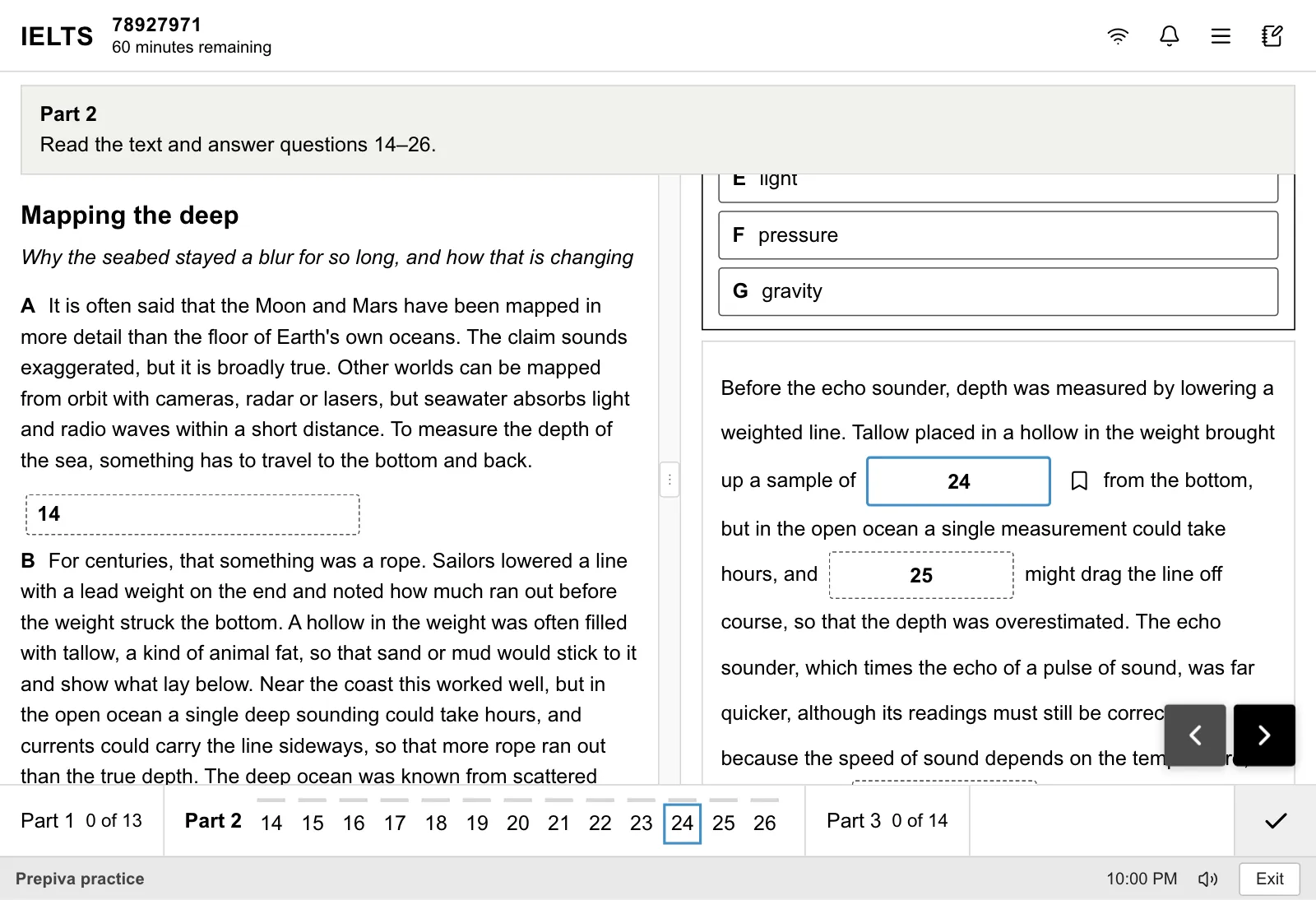
Completion questions give you a summary, notes, a table, a flow chart, sentences or a diagram with gaps, and you fill each gap from the passage. Short-answer questions work the same way, with a question instead of a gap.
By the Prepiva team · Last reviewed · How we make and review our content
On this page
What the task looks like
The gaps sit in the text on screen. Some tasks ask you to type words from the passage, within a limit such as “ONE WORD ONLY” or “NO MORE THAN TWO WORDS AND/OR A NUMBER”. Others give a box of words with letters, and you choose a letter for each gap.
Notes, tables, flow charts and sentences mostly follow the order of the passage. A summary usually covers one part of it; diagram labels may not be in order.
How it is marked
- One mark a gap.
- Words from the passage: copy them exactly as written, spelled correctly.
- Within the limit: an answer over the word limit is wrong.
- The sentence must still work: the right word in the wrong form, such as a plural for a singular, is wrong.
A step-by-step method
- Read the instruction: the word limit, and whether answers come from the passage or from a box.
- Read the title and the first lines, and find the part of the passage they cover.
- For each gap, decide what fits: a noun, a verb, an adjective, a number, singular or plural.
- Scan for words that mean the same as the words around the gap.
- Copy the answer and read the full sentence again with it in place.
- For short answers, underline the question word (what, who, how many) first.
Common traps
- The right word, the wrong form: “manuscripts” where the gap needs “text”.
- Your own word: a good synonym is still wrong if the instruction says to use words from the passage.
- Word-box decoys: words from the passage, used in the wrong place.
- Extra words: an article or a word already printed next to the gap.
A worked example
Writing over writing
Parchment was expensive in medieval Europe, so scribes often reused old manuscripts. They scraped the ink from the surface with a knife or a pumice stone and wrote a new text on top. Centuries later, the earlier writing can sometimes be recovered. Ultraviolet light makes traces of the old ink visible, and scientists have also used X-ray imaging to read words that cannot be seen at all.
Questions 1–3
Complete the summary. Choose ONE WORD ONLY from the passage.
Scribes removed old ink with a knife or a (1) __________ stone, then wrote a new (2) __________ on the same page.
Answer the question. Write NO MORE THAN TWO WORDS.
3. What makes traces of the old ink visible?
| Question | Answer | Why |
|---|---|---|
| 1 | pumice | “Stone” is printed after the gap, so one word is enough. |
| 2 | text | The passage has “manuscripts” nearby, but “a new … on top” is a text, singular. |
| 3 | ultraviolet light | Two words, copied from the passage and within the limit. |
Practise it
In IELTS Academic Practice Test 1, Reading Passage 1 has notes to complete with one word from the passage, and Passage 2 has a summary completed from a box of words. Listening uses the same skills: see form completion.
No account or card to start. Free account to see your report.
FAQ
Do I have to use words from the passage?
When the instruction says to choose words from the passage, yes: copy them exactly. When there is a box of words, choose a letter from the box; those words often mean the same as words in the passage.
Does spelling count in IELTS Reading?
Yes. A misspelled answer is marked wrong, so copy words from the passage carefully.
Are completion answers in passage order?
Usually. Notes, sentences, tables and flow charts tend to follow the passage, and a summary usually covers one part of it. Diagram labels may not be in order.
More on IELTS
- True, False, Not GivenTell False from Not Given in IELTS Reading: what each answer means, a step-by-step method, the common traps and a worked example.
- Matching informationMatching information, matching features and sentence endings in IELTS Reading: which are in order, a method for each and a worked example.
- Form completionForm, note, table and flow-chart completion in IELTS Listening: word limits, spelling, the traps speakers set and a worked example.
Prepiva is an independent practice platform and is not affiliated with, endorsed by or approved by the British Council, IDP: IELTS Australia or Cambridge University Press & Assessment. IELTS is a registered trademark of the British Council, IDP: IELTS Australia and Cambridge University Press & Assessment. Prepiva scores are practice estimates, not official results.