
IELTS Listening Form Completion 2026: Forms, Notes, Tables and Flow Charts
Completion questions ask you to type what you hear into a form, notes, a table, a flow chart or sentences. They come up in most Listening tests, and they are the easiest marks to lose to spelling and word limits.
By the Prepiva team · Last reviewed · How we make and review our content
On this page
What the task looks like
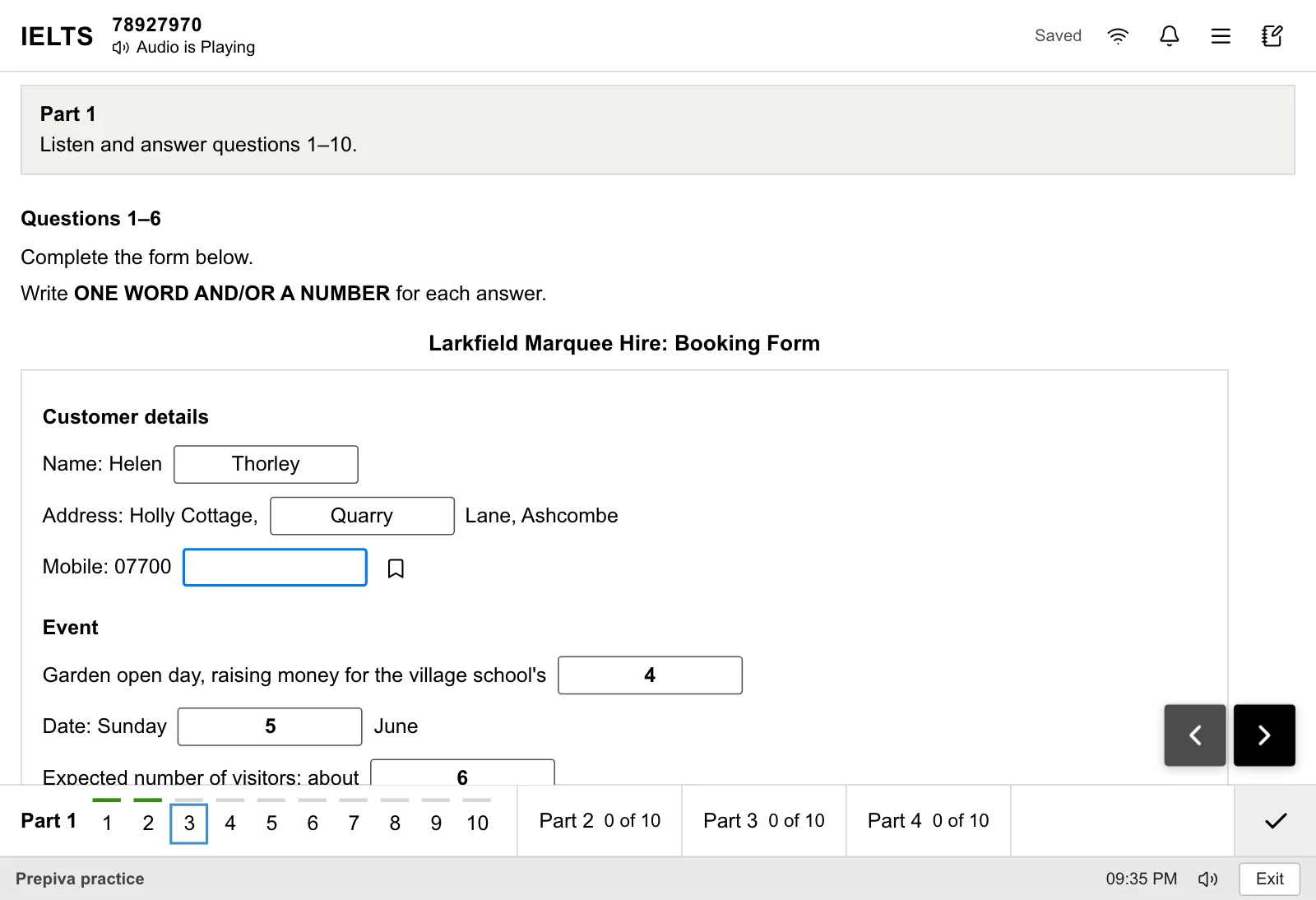
On the computer-delivered test, the form or notes sit on screen with numbered gaps. You click a gap and type. The instruction above sets a word limit, such as “Write ONE WORD AND/OR A NUMBER for each answer”.
Part 1 is often a form: a booking, an enquiry, a registration. Part 4 is often notes on a lecture. You get time to read the questions before each part, and the recording is heard once.
How it is marked
- One mark a gap. The answer must be the word or number you hear.
- Spelling counts. A misspelled answer is wrong. British and American spellings are both accepted.
- The limit is strict. An answer over the word limit scores nothing, even with the right word inside it.
- Numbers can be figures. Write 30, not thirty; 9.30, not half past nine.
A step-by-step method
- Read the instruction and note the word limit.
- In the reading time, look at each gap and guess the kind of answer: a number, a date, a name, a noun, a plural.
- Follow the headings of the form as the speaker moves through it. The gaps come in the order you hear them.
- Listen past the first answer: speakers often correct themselves.
- If you miss a gap, leave it and keep listening for the next one.
- In the 2 minutes at the end, check spelling, plurals and the limit.
Common traps
- Corrections: “Nine o’clock… actually, half past nine.” Only the last version counts.
- Old and new figures: a price that “used to be” one number and is now another.
- Spelled names: letters that sound alike, such as A, E and I, or G and J, and double letters.
- Numbers that sound alike: fifteen and fifty, thirteen and thirty.
- Words already printed: if the form shows £ or “ID”, do not type it again; it can push you over the limit.
A worked example
Recording (extract)
Woman: Riverside Bike Hire, how can I help?
Man: Hi, I’d like to book two bikes for Saturday. The name’s Brennan, B-R-E-N-N-A-N.
Woman: And what time would you like them from?
Man: Nine o’clock… actually, could we make it half past nine? We’re coming by train.
Woman: That’s fine. We also take a deposit. It used to be twenty pounds, but it’s thirty now.
Man: OK. Do I need to bring anything?
Woman: Just some photo ID, please.
Questions 1–4. Write ONE WORD AND/OR A NUMBER for each answer.
Surname: (1) __________
Start time: (2) __________ a.m.
Deposit: £ (3) __________
Bring: (4) __________ ID
| Question | Answer | Why |
|---|---|---|
| 1 | Brennan | Spelled out letter by letter; the double N is easy to miss. |
| 2 | 9.30 | Nine o’clock is corrected. “a.m.” is printed, so the time alone is enough. |
| 3 | 30 | Twenty was the old deposit. The £ sign is printed, so type the number only. |
| 4 | photo | “ID” is printed. Typing “photo ID” would be two words, over the limit. |
Practise it
In IELTS Academic Practice Test 1, Listening Part 1 is a form and a table, and Part 4 is a set of lecture notes, all with word limits and typed answers as on test day. Your report shows each question you missed. See how the raw score becomes a band.
No account or card to start. Free account to see your report.
FAQ
Does spelling count in IELTS Listening?
Yes. A misspelled answer is marked wrong, even if you heard the right word. British and American spellings are both accepted.
What happens if I write more words than the limit?
The answer is marked wrong. If the instruction says NO MORE THAN TWO WORDS AND/OR A NUMBER, a three-word answer scores nothing, even if it contains the right word.
Can I write numbers as figures in IELTS Listening?
Yes. Numbers, dates and times can be written in figures, such as 30 or 9.30, which is quicker and avoids spelling mistakes.
Are the gaps in the same order as the recording?
Yes. The gaps follow the order of the recording, so if you miss one, move on to the next and keep listening.
More on IELTS
- Map labellingHow to label a plan, map or diagram in IELTS Listening: find the start, follow the route and know your direction words. With a worked example.
- Listening multiple choiceSingle-answer, choose-two and matching questions in IELTS Listening: how they are marked, a method, the usual traps and a worked example.
- IELTS test formatEvery part of IELTS Academic: Listening's 4 parts, Reading's 3 passages, Writing Tasks 1 and 2 and the Speaking interview, with timing and question types.
Prepiva is an independent practice platform and is not affiliated with, endorsed by or approved by the British Council, IDP: IELTS Australia or Cambridge University Press & Assessment. IELTS is a registered trademark of the British Council, IDP: IELTS Australia and Cambridge University Press & Assessment. Prepiva scores are practice estimates, not official results.