
IELTS Listening Map Labelling 2026: Plans, Maps and Diagrams
In labelling questions you match places on a plan, map or diagram to what a speaker describes. They often come in Part 2, and they test direction words more than vocabulary.
By the Prepiva team · Last reviewed · How we make and review our content
On this page
What the task looks like
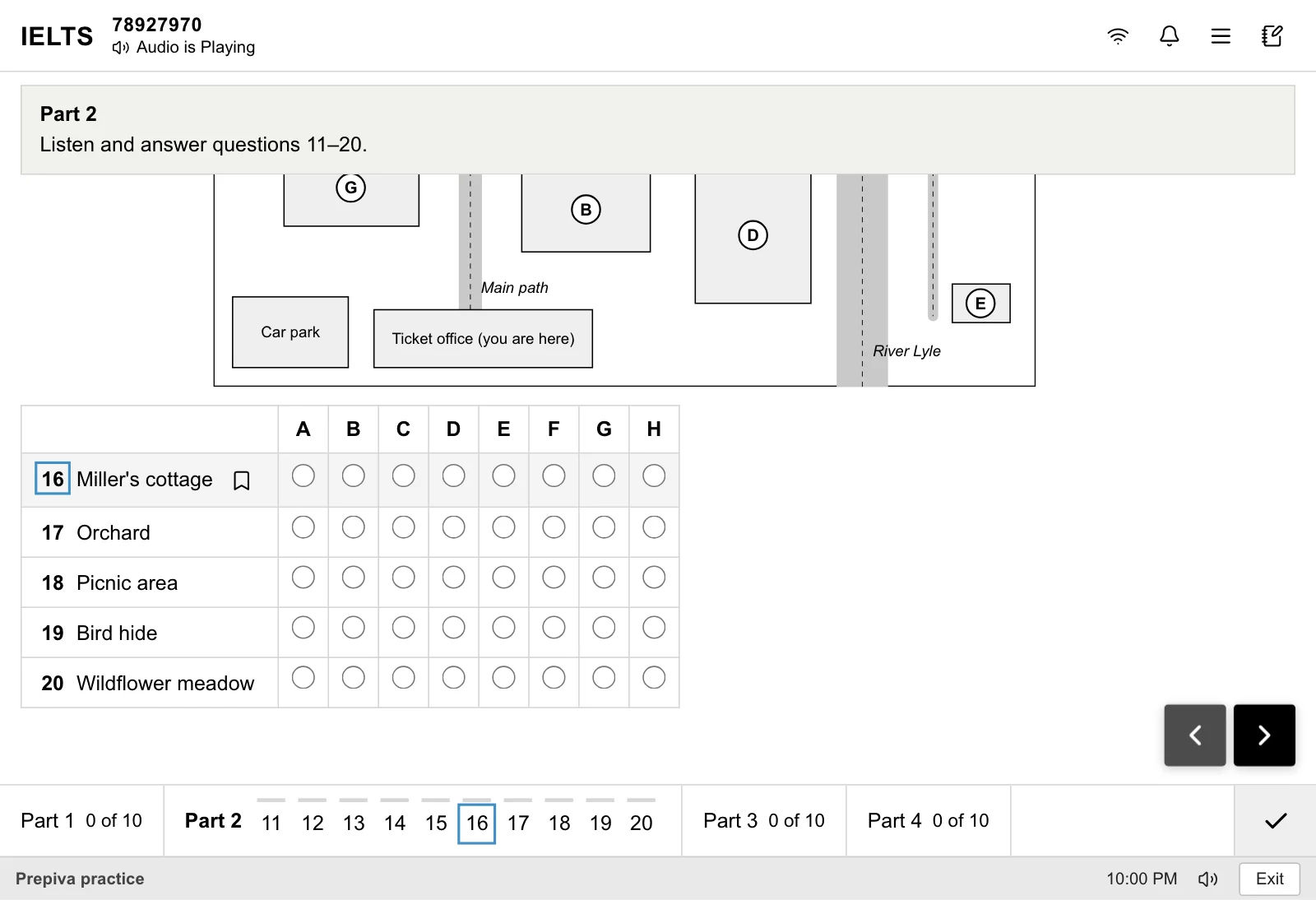
The plan appears on screen with letters, such as A to H, at different places. Below it is a list of numbered places: a café, a car park, a reception desk. For each one you pick the letter where it is.
There are more letters than questions, so some are never used. A diagram of a machine or a process can come instead, with empty labels to type; then the word limit and spelling count as in form completion.
How it is marked
One mark a question, for the right letter. The places are usually asked in the order the speaker reaches them, so the numbers also tell you the route. Usually each letter fits one place at most.
A step-by-step method
- Find the starting point: the entrance, “You are here”, or the compass if there is one.
- Note what is already labelled. The speaker will use those places as landmarks.
- Read the numbered places and picture the route they suggest.
- Follow the speaker with your eyes from the start, place by place.
- If you lose the route, wait for the next landmark and rejoin there.
| The speaker says | On the plan |
|---|---|
| opposite | across the path or road, facing it |
| next to, beside | touching it, on either side |
| just past | the next place after it on the route |
| at the far end | the end away from where you started |
| on your left as you go in | left from the direction of walking, not the page’s left |
Common traps
- Places that moved: “The shop used to be by the gate, but it’s next to the café now.”
- Places that are not asked: the speaker mentions a building near the right letter to distract you.
- Left and right: they follow the speaker’s direction of travel, which may not match the page.
- Losing time: staying on one question while the speaker moves on to the next two.
A worked example
| Letter | Where it is on the plan |
|---|---|
| A | Just inside the main gate, on the left |
| B | Just inside the main gate, on the right |
| C | Beside the fountain, on the left |
| D | Beside the fountain, on the right |
| E | At the far end of the path, on the left |
| F | At the far end of the path, on the right |
Recording (extract)
As you come in through the main gate, the ticket office is on your right. The building on your left is for staff only. Walk straight up the path to the fountain and keep going: the café is at the far end, on your left, and opposite the café you’ll find the toilets.
| Question | Answer | Why |
|---|---|---|
| 1. Ticket office | B | Inside the gate on the right. A, on the left, is the staff building. |
| 2. Café | E | Past the fountain, at the far end, on the left. C and D are only passed. |
| 3. Toilets | F | “Opposite the café”: across the path from E. |
Practise it
In IELTS Academic Practice Test 1, Listening Part 2 ends with a plan to label from letters A to H, after a set of multiple-choice questions. Try it on the clock, with the recording heard once.
No account or card to start. Free account to see your report.
FAQ
Which part of IELTS Listening has map labelling?
It is most often in Part 2, where one speaker describes a place, but a plan or diagram can appear in other parts too.
Do I write words or letters in map labelling?
On a plan or map with letters, you choose a letter for each place. On a diagram with empty labels you type words, within the word limit, and spelling counts.
How do I know left and right on an IELTS map?
Follow the speaker. Left and right are usually from the direction the speaker is walking, so trace the route from the starting point as you listen.
More on IELTS
- Form completionForm, note, table and flow-chart completion in IELTS Listening: word limits, spelling, the traps speakers set and a worked example.
- Listening multiple choiceSingle-answer, choose-two and matching questions in IELTS Listening: how they are marked, a method, the usual traps and a worked example.
- IELTS test formatEvery part of IELTS Academic: Listening's 4 parts, Reading's 3 passages, Writing Tasks 1 and 2 and the Speaking interview, with timing and question types.
Prepiva is an independent practice platform and is not affiliated with, endorsed by or approved by the British Council, IDP: IELTS Australia or Cambridge University Press & Assessment. IELTS is a registered trademark of the British Council, IDP: IELTS Australia and Cambridge University Press & Assessment. Prepiva scores are practice estimates, not official results.