
IELTS Speaking Part 3 2026: Discussion Questions and How to Extend Your Answers
Part 3 is a four-to-five-minute discussion of broader questions linked to the Part 2 topic. It asks for opinions, comparisons and predictions, and for longer answers with reasons.
By the Prepiva team · Last reviewed · How we make and review our content
On this page
What happens in Part 3
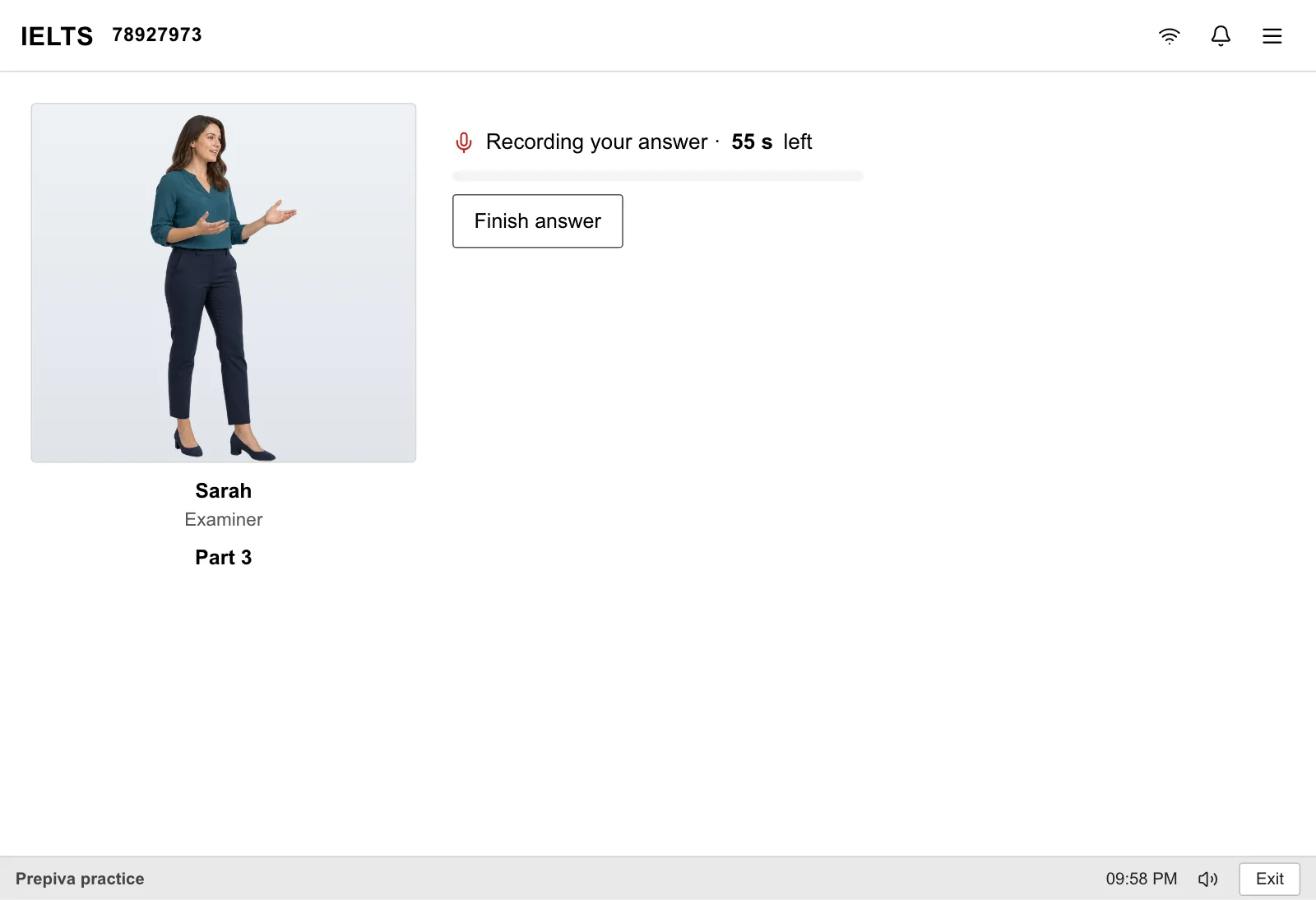
The questions move from your own experience to people and society in general: why things happen, how they compare, what might change. On test day the examiner may ask follow-up questions or challenge your view. In the Prepiva test a recorded examiner asks a set of discussion questions, with up to a minute for each answer.
How it is marked
The same four criteria: Fluency and Coherence, Lexical Resource, Grammatical Range and Accuracy, and Pronunciation. Part 3 is where range shows: explaining, comparing, speculating and qualifying an opinion all call for more complex language than Part 1.
A simple structure
| Step | Useful language |
|---|---|
| Give your view | I’d say… / To some extent… / It depends on… |
| Give a reason | mainly because… / The main reason is… |
| Give an example | For instance… / In my country… |
| Add a contrast | That said… / On the other hand… |
Move from the personal to the general. It is fine to take a moment (“That’s not something I’ve thought about before…”), but answer the question you were asked.
Common traps
- Only personal stories: Part 3 asks about people in general.
- Very short answers: one sentence is a Part 1 answer.
- The same set phrases at the start of every answer.
- Going back to your Part 2 story instead of the wider question.
A worked example
Question
Do young people today learn less from older generations than in the past?
A strong answer
To some extent, yes. A lot of practical knowledge used to pass from grandparents to grandchildren simply because families lived closer together. Now, if you want to learn to cook or fix something, you’re more likely to watch a video. That said, I don’t think the knowledge has disappeared; it has moved. Many of the people making those videos are older people themselves, so the teaching still happens, just with strangers.
A view (“to some extent, yes”), a reason (families lived closer), an example (videos) and a contrast (“that said”) in about 30 seconds of speech.
Practise it
In IELTS Academic Practice Test 1, Part 3 follows the cue card with six discussion questions on the same theme. Your answers are transcribed and rated on the four criteria. See how the Speaking band is worked out.
No account or card to start. Free account to see your report.
FAQ
How long should my answers be in IELTS Speaking Part 3?
Longer than in Part 1: often four or five sentences, about 30 seconds to a minute, with a reason and an example.
What if I have no opinion on a Part 3 question?
Say what you think is likely, or compare two sides. You are rated on how you express ideas, not on which view you take.
Can the examiner interrupt me in Part 3?
Yes. Part 3 is a discussion, so the examiner may ask a follow-up question or move on. That is normal and not a sign of a weak answer.
More on IELTS
- Speaking Part 1IELTS Speaking Part 1: what the examiner asks, how long to answer, the four criteria and short versus extended sample answers.
- Speaking Part 2IELTS Speaking Part 2: one minute to prepare, up to two minutes to talk. How to make notes, fill the time and a worked cue card example.
- IELTS band scoresHow IELTS is scored: the 0–9 bands, Listening and Academic Reading raw scores to bands, the Writing and Speaking criteria and how the overall band is rounded.
Prepiva is an independent practice platform and is not affiliated with, endorsed by or approved by the British Council, IDP: IELTS Australia or Cambridge University Press & Assessment. IELTS is a registered trademark of the British Council, IDP: IELTS Australia and Cambridge University Press & Assessment. Prepiva scores are practice estimates, not official results.