
IELTS Speaking Part 2 2026: The Cue Card, One Minute to Prepare and Two Minutes to Talk
In Part 2 you get a cue card with a topic and a few prompts, one minute to prepare, and then up to two minutes to talk on your own. A simple plan for the minute makes the two minutes easy to fill.
By the Prepiva team · Last reviewed · How we make and review our content
On this page
What happens in Part 2
The card asks you to describe something, such as a person, a place or an event, and lists three or four things to say, ending with a prompt to explain why. You get paper and a pencil and one minute to make notes. Then you talk for up to two minutes; the examiner stops you at the time and may ask one or two short questions. The whole part takes 3 to 4 minutes.
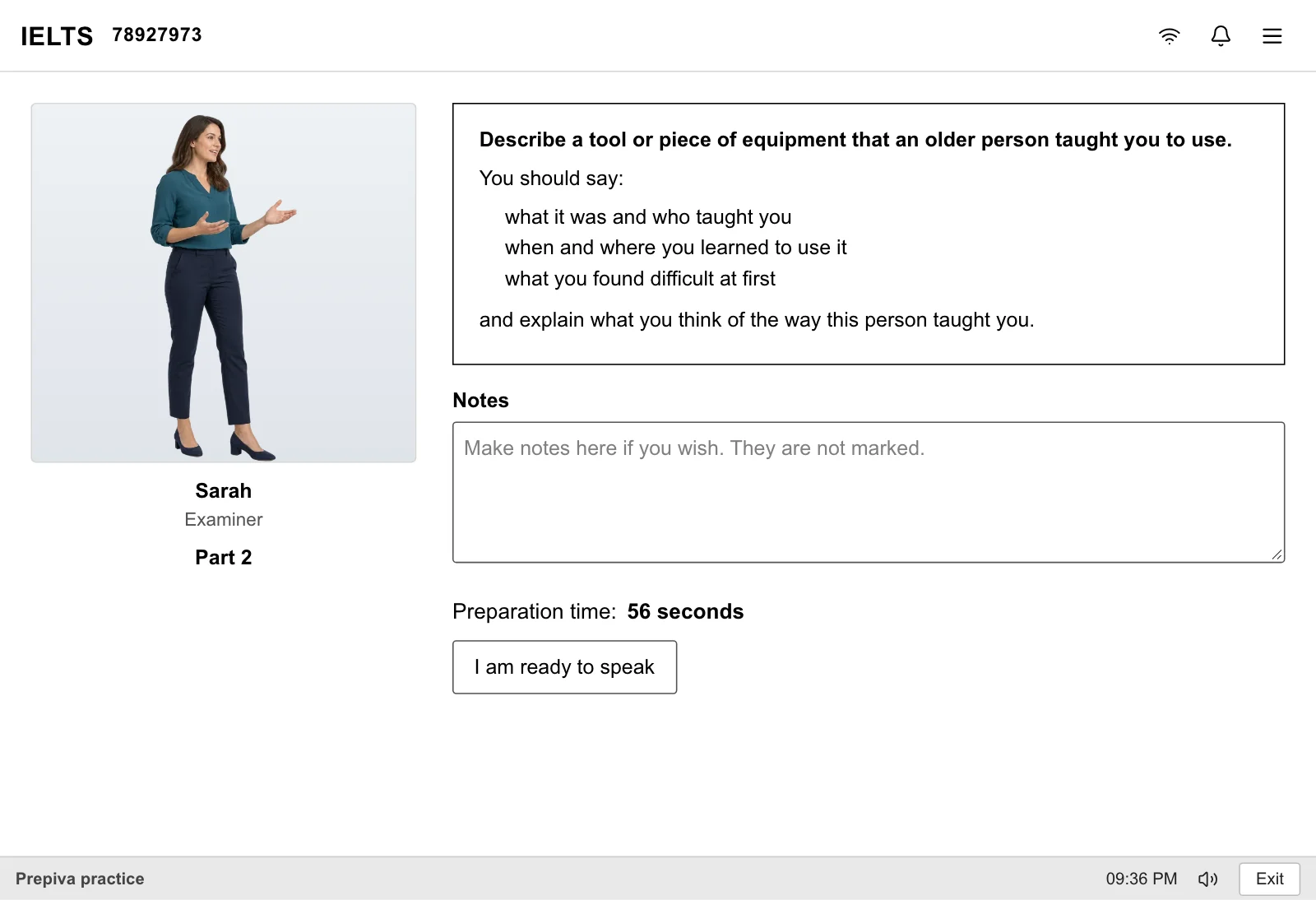
On test day the examiner gives you the card. In the Prepiva test the card appears on screen with a one-minute timer, and your talk is recorded for up to two minutes.
How it is marked
The same four criteria as the rest of Speaking: Fluency and Coherence, Lexical Resource, Grammatical Range and Accuracy, and Pronunciation. Part 2 shows whether you can speak at length and keep a talk organised. You are rated on your English, not on whether the story is true.
A step-by-step method
- Choose your subject in the first 10 seconds: the first idea you can talk about easily.
- Write keywords, not sentences: one line for each prompt and one for the “explain” line.
- Open with one sentence that says what you will talk about.
- Follow the prompts in order, glancing at your notes.
- Spend the most time on the “explain” part: feelings, reasons, what changed.
- If you run out, add a detail or compare then and now. Keep going until you are stopped.
Common traps
- Half the minute spent choosing a subject.
- Full sentences in the notes: there is no time, and reading them aloud sounds flat.
- Stopping at one minute: a short talk gives less evidence of fluency.
- A memorised talk bent to fit a different card.
A worked example
Cue card
Describe a skill you learned from an older person.
You should say: who the person was, what the skill was, how they taught you, and explain why the skill has been useful to you.
One minute of notes
grandad Ilya · fixing bikes · summers, age 12 · watched first, then did it, he only pointed · useful: no repair bills, patience, help friends now
The opening
I’d like to talk about my grandfather, Ilya, who taught me to repair bicycles when I was about twelve. We spent most summers at his house, and his garage was full of old bikes that neighbours had given him…
Five short notes cover every prompt. The opening names the person and the skill at once, so the rest of the talk can follow the notes.
Practise it
In IELTS Academic Practice Test 1, Part 2 gives you a cue card with one minute to prepare, up to two minutes to talk and two short follow-up questions. Your talk is transcribed and rated on the four criteria.
No account or card to start. Free account to see your report.
FAQ
How long should I speak in IELTS Speaking Part 2?
Up to two minutes; the examiner stops you then. Aim to keep going until you are stopped, since a much shorter talk gives less evidence of fluency.
Can I take notes in Part 2?
Yes. You get one minute with paper and a pencil to make notes, and you can look at them while you speak.
Does my Part 2 story have to be true?
No. You are rated on your English, not on the facts. If nothing true comes to mind, use a story you can tell easily.
What if I finish before two minutes?
Add a detail: how you felt, what you would do differently, or how things have changed since. The examiner may also ask a short question to help you go on.
More on IELTS
- Speaking Part 1IELTS Speaking Part 1: what the examiner asks, how long to answer, the four criteria and short versus extended sample answers.
- Speaking Part 3IELTS Speaking Part 3: the discussion after the cue card. A four-step structure to extend your answers, common traps and a model answer.
- IELTS study planPrepare for IELTS Academic in four steps: take a full mock test, find your weakest skill, train it on the band criteria and test again before you book.
Prepiva is an independent practice platform and is not affiliated with, endorsed by or approved by the British Council, IDP: IELTS Australia or Cambridge University Press & Assessment. IELTS is a registered trademark of the British Council, IDP: IELTS Australia and Cambridge University Press & Assessment. Prepiva scores are practice estimates, not official results.