
IELTS Speaking Part 1 2026: Questions, Answer Length and Sample Answers
Part 1 is the first four to five minutes of Speaking: short questions about you, your home, your work or studies and familiar topics. Natural answers of two or three sentences work best.
By the Prepiva team · Last reviewed · How we make and review our content
On this page
What happens in Part 1
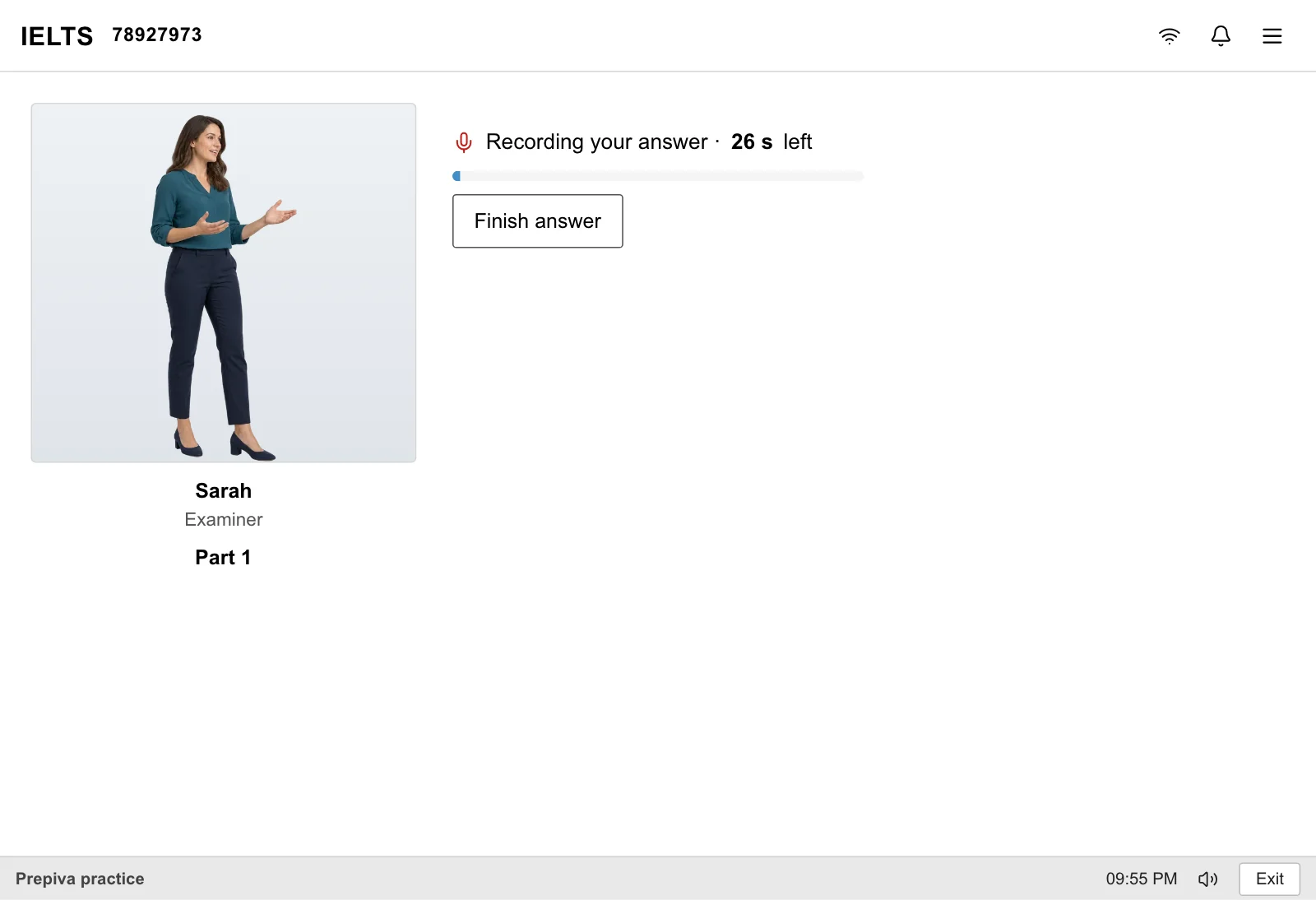
The examiner introduces themselves, checks who you are and asks questions on two or three everyday topics. On test day it is a real examiner, face to face or by video call, and the interview is recorded. In the Prepiva test a recorded examiner asks each question and you answer into your microphone, with about 30 seconds an answer.
How it is marked
Speaking is rated across all three parts on four equally weighted criteria: Fluency and Coherence, Lexical Resource, Grammatical Range and Accuracy, and Pronunciation. There is no separate score for Part 1, but it is where the examiner first hears how you speak. Pronunciation is about being easy to understand, not about a particular accent.
A simple method
- Answer the question directly in the first few words.
- Add a reason, an example or a detail.
- Stop after two or three sentences, about 15 to 25 seconds.
- Use the tense of the question: “Did you…” wants the past.
- If you did not catch a question, ask: “Could you repeat that, please?”
Common traps
- One-word answers: “Yes.” gives the examiner nothing to rate.
- Prepared speeches: they sound recited and often miss the question.
- Long answers that drift: Part 1 is short; save longer answers for Parts 2 and 3.
- Repeating the question word for word before you answer.
Sample answers
| Question | Too short | Better |
|---|---|---|
| Do you enjoy cooking? | Yes, I do. | Yes, especially at weekends, when I have time to try something new. Last Sunday I made a lentil soup from my grandmother’s recipe, and it turned out well. |
| Do you prefer mornings or evenings? | Evenings. | Evenings, really. I’m slow to get going early on, but after dinner I can focus, so that’s when I usually study. |
| How often do you use public transport? | Every day. | Almost every day. I take the tram to work because parking in the centre is hard to find, and I can read on the way. |
Practise it
In IELTS Academic Practice Test 1, Speaking Part 1 has ten short questions from a recorded examiner. Your answers are recorded, transcribed and rated on the four criteria. Then go on to the Part 2 long turn.
No account or card to start. Free account to see your report.
FAQ
How long should my answers be in IELTS Speaking Part 1?
Two or three sentences, about 15 to 25 seconds. Answer the question, then add a reason or an example.
Can I ask the examiner to repeat a question?
Yes. Asking “Could you repeat that, please?” is fine. In Part 1 the examiner can repeat the question but will not explain it.
What topics come up in IELTS Speaking Part 1?
Your home or hometown, your work or studies, and everyday topics such as food, weather, music or weekends. The topics change from test to test.
Is IELTS Speaking with a real person?
On test day, yes: an examiner, face to face or by video call. In the Prepiva test a recorded examiner asks the questions and your answers are recorded.
More on IELTS
- Speaking Part 2IELTS Speaking Part 2: one minute to prepare, up to two minutes to talk. How to make notes, fill the time and a worked cue card example.
- Speaking Part 3IELTS Speaking Part 3: the discussion after the cue card. A four-step structure to extend your answers, common traps and a model answer.
- IELTS test formatEvery part of IELTS Academic: Listening's 4 parts, Reading's 3 passages, Writing Tasks 1 and 2 and the Speaking interview, with timing and question types.
Prepiva is an independent practice platform and is not affiliated with, endorsed by or approved by the British Council, IDP: IELTS Australia or Cambridge University Press & Assessment. IELTS is a registered trademark of the British Council, IDP: IELTS Australia and Cambridge University Press & Assessment. Prepiva scores are practice estimates, not official results.